

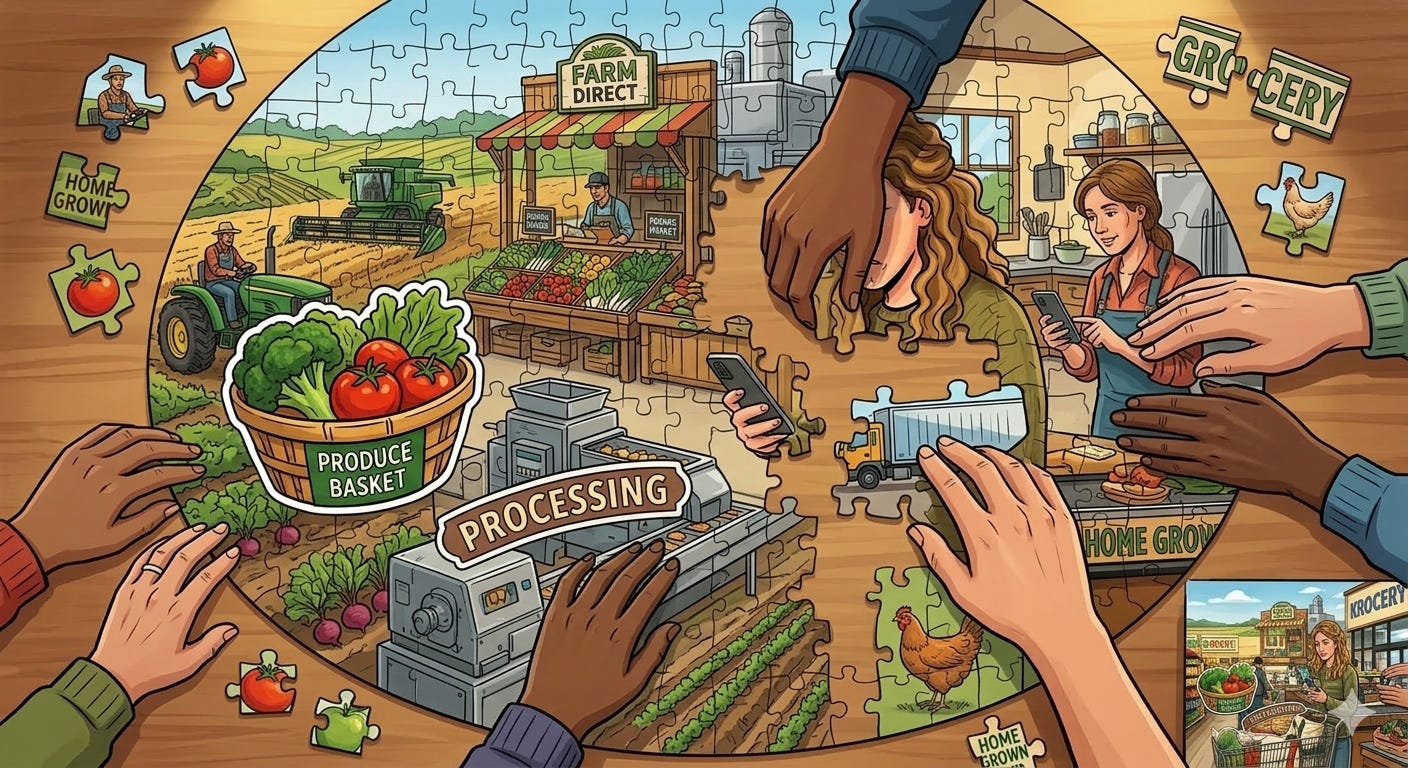
A companion summary to the Food Puzzle series (Parts 1–14)
This memo summarizes the core empirical findings from the Food Puzzle series (Parts 1–14) for quick reference.
The Core Paradox
U.S. agriculture has undergone one of the most dramatic productivity transformations in modern economic history. From 1948 to 2021, agricultural Total Factor Productivity (TFP) grew by an average of 1.49% per year, with output nearly tripling while aggregate inputs were flat or declining. The TFP index alone, rising from 0.37 in 1948 to 1.01 in 2021, implies roughly 66.2% expected cost savings at the farm level over that period. Yet CPI‑deflated farm expenses fell only about 20.2%, and per‑capita food revenue in the USDA Food Dollar series has been essentially flat in real terms from 1967 to 2023. The physical economy and the CPI‑measured economy cannot both be right; the Food Puzzle is a systematic attempt to reconcile them.
Parts 1–2 | The Agricultural Anomaly
The anomaly is not confined to the post‑1980 era. From 1948 to 1980, TFP growth implies roughly a 31.37% decrease in real farm expenses, yet CPI‑adjusted per‑capita agricultural expenses increase by 38.37%, a gap of nearly 70 percentage points. Even allowing for the late‑1970s input cost bubble (energy, interest rates, weather shocks), the discrepancy remains too large to dismiss as a cyclical artifact. Post‑1980, TFP implies about 50.8% cumulative cost savings, while CPI captures only about 40.7%, heavily influenced by the same high‑inflation bubble period in the 1970s and early 1980s.
Over the same window, a standard food basket requires 44% fewer work hours in 2024 than in 1980 (2.32 hours vs. 1.30 hours), indicating that productivity translated into higher purchasing power at the household level. Under CPI, that gain is attributed mostly to rising wages, combined with only modest declines in food prices. That attribution is hard to reconcile with the rest of the agricultural monetary data: today’s farm labor force is smaller than in 1948, yet farms produce more food with fewer inputs. On those physical terms, per‑capita food costs should be dramatically lower, not roughly similar or only slightly cheaper than in the mid‑20th century.
Parts 3–5 | The Supply Chain Defense Fails
The most intuitive explanation is that farm‑level savings were absorbed downstream by processing, packaging, transportation, wholesale, and retail. That story fails on its own terms. Each downstream sector experienced its own productivity boom over the same period, which should have compounded the farm‑level savings rather than offsetting them. USDA ERS data show that CPI deflated per‑capita costs in packaging, transport, and food manufacturing were flat or declining, even as the farm share of the food dollar fell to roughly one‑quarter for food‑at‑home, broadly in line with its historical range. A shrinking farm share is therefore better read as evidence that farms have become relatively more productive than the rest of the chain, not that downstream sectors absorbed the entire productivity dividend; the unresolved gap lies in how the dollar aggregates that joint productivity record.
A note on methodology: invoking industry‑specific deflators (USDA Prices Paid/Received indices, BEA sector deflators) to “fix” this discrepancy concedes the core point. If CPI requires a patchwork of sector‑by‑sector corrections to line up with physical quantities in its most data‑rich sector, it fails as an economy‑wide price index. The Food Puzzle standard is stricter: the goal is not to make agriculture’s numbers work in isolation, but to identify a single inflation adjustment that simultaneously reconciles physical and monetary realities across the whole economy.
Parts 6–7 | Corporate Profit Margins Are Not the Culprit
A second common explanation is that concentrated market power in branded food allowed large corporations to capture the productivity dividend. Analysis of 10 major food companies, including Tyson, Coca‑Cola, and PepsiCo, shows stable or declining net profit margins over the relevant period. If corporate concentration were absorbing the productivity gains, margins would be widening over time; they are not. Market power is concentrated in branded and discretionary segments, not in staple food categories, where productivity gains are largest, and the puzzle is sharpest.
Part 8 | External Shocks Are Transitory, Not Structural
Supply disruptions, droughts, the COVID‑19 pandemic, and the Russia‑Ukraine war are frequently cited as explanations for persistently high food prices. The Russia‑Ukraine conflict provides the cleanest recent natural experiment: global food commodity prices spiked in 2022, then largely reverted toward their pre‑shock trend. Such episodic shocks generate temporary price volatility, not the decades‑long structural divergence between TFP‑implied cost savings and CPI‑adjusted price levels documented in the agricultural data.
Part 9 | Regulation Is Already in the TFP Measurement
Regulatory burden is sometimes raised as an explanation for why productivity gains do not translate into lower consumer prices. This objection misreads what TFP measures. Regulations that raise input costs, additional compliance labor, capital equipment, and materials are already captured on the input side of the TFP accounts. Regulations that restrict output reduce the index directly on the output side. The ~50.8% implied cost savings from 1980 to 2021 are therefore a net‑of‑regulation figure, not a pre‑regulation hypothetical. Regulation cannot be embedded in TFP on both the input and output sides and then be invoked again as an independent explanation for why TFP‑implied savings failed to reach consumers.
Parts 10–15 | The Stress Test
With the standard explanations eliminated, the Food Puzzle turns to the measurement of inflation itself. The official CPI serves as the baseline, but it fails the stress test on its own terms before any alternative is applied. Across 16 common food items, 1980 prices adjusted forward to 2024 using official CPI show an average real price decline of only ~3.12%. Against a productivity record implying roughly 40–50% real cost reductions in many staple categories, CPI’s own numbers leave most of the expected savings unaccounted for. A measuring stick that cannot reconcile a century of documented physical productivity gains with the prices consumers actually pay fails to capture the full economic reality.
The question then becomes whether any adjustment to CPI closes this gap without generating new contradictions elsewhere in the data. Three prominent alternatives are applied retroactively to the same 44 years of price data across 16 common items.
Boskin Commission (~1.1% annual overstatement). Applying the Commission’s estimated bias retroactively produces an average real food price increase of ~60% since 1980 across all 16 items, the opposite of what the productivity record predicts. Under Boskin’s logic, real wages rise ~140% and real GDP per capita ~213% since 1980, which is difficult to reconcile with declining intergenerational mobility, falling under‑35 homeownership, and persistent cost‑of‑living distress in survey data.
ShadowStats / Chapwood (~7% annual understatement from 2000 onward). This adjustment yields an average real food price decrease of ~81% since 1980, far beyond even generous readings of agricultural TFP gains (~40–60%). It implies 1980 wages of about $238,518 in 2024 dollars, a 72% real-wage collapse, and median home prices of around $1.27 million, an economic depression worse than the 1930s, which clearly did not occur.
NETs 1.2–1.8% annual understatement, centered on 1.5%. A modest, directionally inverted application of Boskin’s insight, that CPI systematically misses the deflationary force of productivity, resolves the puzzle cleanly. Real food prices then fall broadly in line with TFP‑implied savings, while real wages, housing, and GDP per capita remain internally consistent with observable living standards.
The final validation comes from classical monetary theory. When each inflation measure is expressed as a cumulative multiplier and plotted against per capita M2, the standard monetary driver of price levels, the NETs adjustment tracks per capita M2 most closely. Official CPI and Boskin sit far below any plausible path of monetary expansion, while ShadowStats/Chapwood exceeds even the monetary base. The NETs adjustment is the only measure that remains consistent with both the food‑price evidence and the monetary aggregates.
Conclusion
The Food Puzzle is not a critique of any single data series. It is a reconciliation test: can the economy’s most data‑rich, most physically measurable sector, agriculture, be made to tell a coherent story when CPI is used as the inflation deflator? After eliminating every standard explanation and stress‑testing every prominent CPI alternative, the answer is no. A systematic CPI understatement of 1.2–1.8% per year, centered on 1.5%, is the only adjustment that resolves the paradox without generating new contradictions elsewhere in the data. The implications extend well beyond food: if CPI understates inflation by this margin, then real wages, real GDP, and real living standards have been persistently mismeasured, and the widespread sense that the economy is failing ordinary households is not a sentiment problem, but a measurement problem.
To keep this summary compact, detailed methodology and source references are omitted. For questions about how any figure was derived, please refer to the article parts cited in each subheading above, where full methodology, data sources, and calculations are documented.
Next,
Why Agriculture is the Perfect Smoking Gun: Food Puzzle, Part 1
"This is the short version. For the full case with the receipts, start at 'Why Agriculture Is the Perfect Smoking Gun,' Part 1 of the Food Puzzle series."
Author: Kyle Novack
May 9, 2026
A Monumental Venture, LLC: research project (Novack Equilibrium Theory – NETs)
Attribution Required: © 2025–2026 Kyle Novack / Monumental Venture, LLC. For educational use with credit; commercial use requires permission. Full details in linked PDFs.