

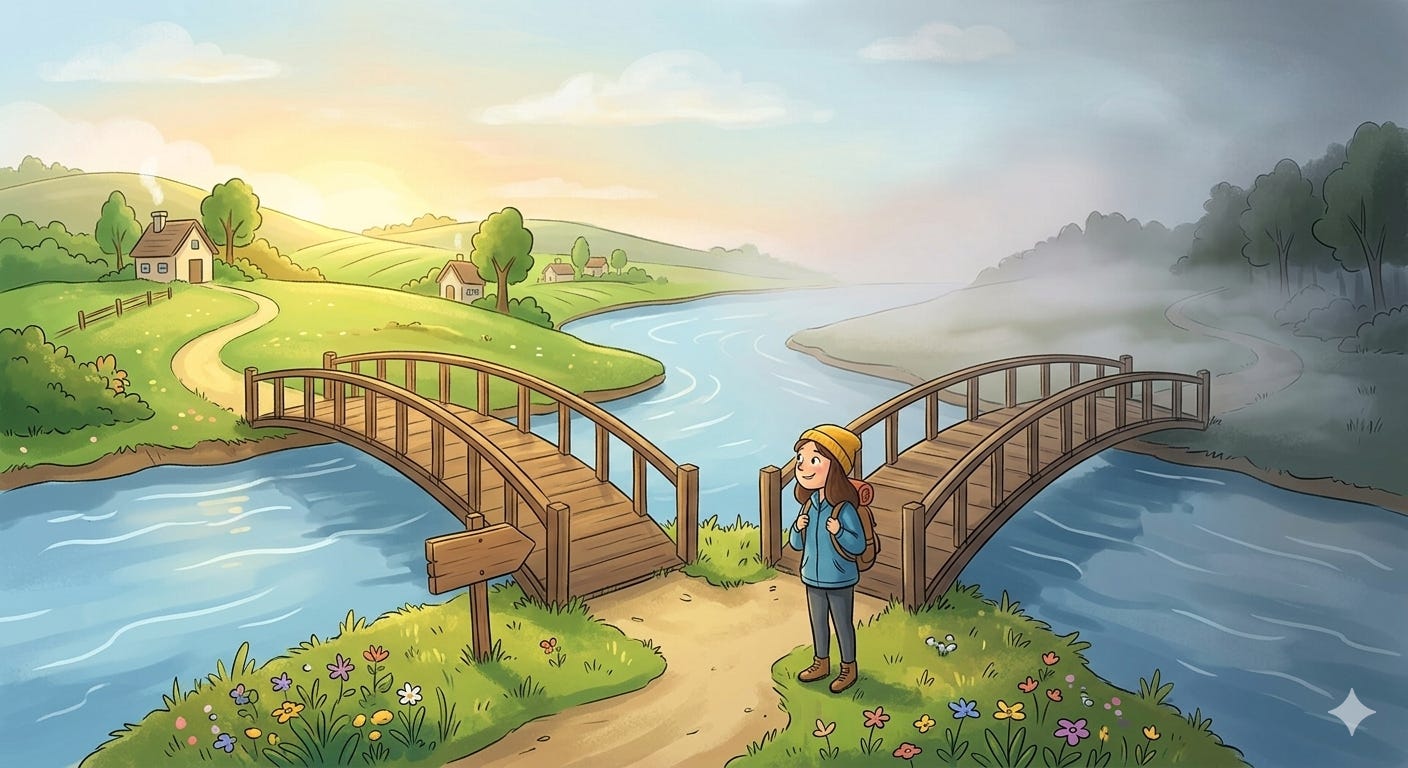
Most people have a version of the life they want. A home. Travel. A family. Enough time and enough money to feel like the days belong to them. That the grind is not the point. That vision is real, and for most people it has been sitting in the back of their mind since their twenties: more feeling than plan, more aspiration than commitment.
Notice what is missing from that list. The work. The career. The business. Most people treat work as a vehicle, the thing that funds everything else, and leave it at that. But that framing sells it short. Work is too connected to your sense of purpose, your identity, your daily experience of being alive to be treated as a means to an end and nothing more. It deserves a deliberate place in the life you are designing.
The problem is not that people include work. The problem is that most people set the shore as a life without work, which is the wrong target. It demands financial independence as the price of admission, and that leaves most people with only two options: sacrifice everything now and build as fast as possible, giving up the life you want in order to eventually have it, or play the long game and arrive too late to enjoy what you were building toward. Both options ask you to defer the life you actually want in exchange for a better future that may never arrive the way you imagined it. Most people end up somewhere between the two, which means they miss both. Not because they did not work hard enough, but because they never defined a third option.
That third option is becoming increasingly possible. Not financial independence as the finish line, and not forty years of deferred living. A business or career built deliberately around the life you are designing, one that funds the presence with the ones you love. The freedom. The experiences while you are still young enough for it to matter.
Those things are not the reward at the end. They are the point. The goal is not to escape the work. It is to integrate work into what you want your life to be, so that retirement is no longer the shore you are building toward, because you stopped waiting for permission to live. For a long time, that kind of life felt like it required a trade most people could not afford to make. That is no longer true.
If that lands, you already know why what comes next matters so much.
In the last piece, I asked you to keep walking. I told you that the slow, invisible, unrewarding stretch of the bridge was not a sign you were failing. It was just the incline. Keep going. Trust the process.
And I meant every word of it.
But there is a question I left sitting underneath that advice, unexamined. A question that, if you do not answer it honestly, makes all the walking in the world beside the point.
What if you are on the wrong bridge? Or better put: what if you are building toward the wrong shore?
Not the wrong path in some vague, philosophical sense. But the wrong bridge in a very specific, practical one: the bridge you are walking leads to a shore you never actually decided you wanted to reach. You are not behind. You are not failing. You are just headed somewhere you did not choose.
Grit on the wrong bridge is not a virtue. It is just expensive mileage.
The Question Nobody Packages
Before you keep walking, there are some questions worth sitting with. The first is the most important one: What does the shore on the other side of the bridge look like? Not the category. Not the feeling. The specific, honest picture of what enough looks like for you.
There is no shortage of good advice about how to build. The playbooks are useful. The frameworks are real. The people behind them are asking the right questions and genuinely trying to help. But most of them start at the bridge, because the bridge is where the action is, where progress is visible, where the work is concrete enough to teach. There are people who do address the destination question, but most of them arrive with their own answer already in hand, a set of values or a framework they invite you to adopt rather than helping you find your own. The shore question gets assumed rather than examined, not out of carelessness, but because it is the hardest step to package. There is no right answer, and that makes it the most personal one.
That is the step this work is about. Not a replacement for the playbooks. Not a better set of values to build around. Just the work that has to happen before any of that becomes useful, figuring out what your values actually are, what your normal Tuesday looks like, who is in it, and what you are not willing to trade. Once you have that, the playbooks work the way they were meant to. They stop being destinations and become tools in service of something genuinely yours.
This is where the real work begins. Not the kind with a clean answer. The kind that guides you when you return to building.
The Assumption Nobody Wrote Down
The most foundational of these is also the one most people have never explicitly answered. They leave it as an assumption.
How do you want your life to be distributed?
Not just between work and rest. Between everything. The time you spend building something and the time you spend living inside what you have built. The mornings that belong to your work and the mornings that belong to your family. The time you spend accumulating and the time you spend being present for the people who will remember you. The hobbies that keep you human and the travel that reminds you the world is larger than your current problems. The agency over your own hours, the ability to say yes to what matters and no to what does not, without having to ask permission.
So, when you think about how you want your life to look, the question is not just how much of it goes to work. It is how all of it gets divided, and whether the distribution you are currently living matches what you would choose if you stopped and decided deliberately.
I cannot tell you what your right distribution is. Nobody can. It is personal, and it requires a deep understanding of yourself to get as close to right as you can. This is not something that can be perfected. It can only be pursued honestly.
Until you know your distribution, you do not have a shore. You have a direction. And directions, without a shore, are just expensive mileage with nothing waiting on the other side.
The Covenant: What Are You Not Willing to Trade?
There is a practical tool underneath all of this. It is simpler than most of what gets written about building a new life. But it requires you to be honest with yourself.
Before you build anything, write down what you are not willing to trade.
Not goals. Not aspirations. Not the things you hope to gain. The things you are not willing to lose, the specific, concrete, non-negotiable elements of the life you are building toward. These are not values in the abstract sense. They are structural commitments about what does not get sacrificed in the name of progress.
Call it a covenant with yourself. And then, every time a new opportunity appears, every time something lands on your calendar uninvited, every time something that looks like progress shows up and asks for a yes: test it against the covenant.
Does this protect what I am building toward, or does it quietly erode it?
That question will not always produce a clean answer. Sometimes the right move genuinely requires trading something temporarily to get somewhere better. That is a legitimate choice, as long as it is a conscious one. The problem is not making trades. The problem is making trades you never noticed you were making, until one day you look up and the thing you were protecting is gone.
To make this concrete, there is an old parable that illustrates exactly what is at stake.
A fisherman pulls his boat ashore mid-morning with enough fish for his family. A businessman on the dock asks why he stopped so early. The fisherman tells him: he has what he needs. He will spend the afternoon with his children, have dinner with his wife, and play music with his friends in the evening.
The businessman sees the fisherman’s situation and believes he could have more. He lays out a plan he believes will revolutionize the fishermen’s life. Bigger boats. Larger catches. Eventually, a fleet, a processing operation, and real money. The fisherman listens with interest because that new lifestyle might be worth it. He asks how long that takes. Twenty years, maybe twenty-five. And after that? The businessman smiles. After that, you retire. You spend your mornings fishing, your afternoons with your children, your evenings with your friends.
The fisherman looks at him and says nothing.
But there is a part of the parable that is only implied. Let me say it plainly. The fisherman could have said yes, and many of us would have. You hear the plan, it sounds compelling, and you shake the businessman’s hand and start building. And twenty years later, if you never stopped to test each decision against what you were actually protecting, you might arrive at retirement to find you spent two decades building your way back to the morning you were already living.
Or worse: you get there and pick up the rod, and feel nothing. The thing that made the morning worth having, the quiet, the rhythm, the small daily satisfaction of bringing home exactly enough, got buried somewhere under the fleet, the cannery, the payroll, the pressure. You did not just build past your shore. You built over it. You took the thing that gave your life meaning and turned it into the engine of an enterprise, and somewhere in that process, lost the thread back to why it mattered.
The parable is not about ambition or minimalism. It is about knowing what your covenant requires before you say yes to building the bridge to your shore. For most of us, the situation is rarely this clear. The shore needs funding. The plan needs to evolve. Adaptation is not just allowed, it is required. So what does that actually look like?
Adapting Is Not the Same as Jumping Off
You have done the foundation work. You are on the bridge. But unlike a typical bridge, you do not need the full build mapped out before you start. You do not know every material, every span, every adjustment the terrain will require. But you know the shore on the other side. That is the covenant you made for yourself.
But imagine partway through building, you decide you are headed to the wrong shore entirely. So you jump off and start over toward a new one. Then you jump off that one too. And again after that.
You are no longer building. You are wasting time and effort. You are covering ground without covering distance. After an enormous amount of effort and expense, you are nowhere you chose to be.
This is exactly what happens when you start building a new life without a shore you have genuinely committed to. Every new idea feels like an opportunity. Every pivot feels like wisdom. But underneath it, what is actually happening is that the shore keeps moving, so the progress never compounds.
The plan, on the other hand, is allowed to change. This is important.
Halfway through the build, you decide to slow down and make the structure beautiful rather than just functional. Further along, you realize steel serves you better than concrete, and you adapt. That is not an inconsistency. That is building. The plan is the structure that adapts. The shore is the commitment to yourself.
Most of the confusion people feel about whether they are on the right path is not shore confusion. It is plan confusion. They changed how they were building, felt disoriented, and decided they must be going to the wrong place. The question worth asking is not whether your plan looks different from what it did a year ago. The question is whether the shore you are building toward is still the shore you chose.
Say your shore is becoming a life coach. You start writing articles. Then you pivot to making videos because the audience responds better. You build a website. You narrow your focus to financial coaching because that is where your experience is strongest. Every one of those decisions looks like a change. None of them is a shore change. You are still building toward the same place. The plan adapted. The commitment held.
Now consider a more dramatic version. Halfway through building that coaching practice, you decide to stop coaching entirely and start training other coaches instead. That looks like a shore change. It might not be. If what you were always building toward was helping people build better lives at scale, then training coaches serves that goal more powerfully than coaching individuals ever could. The bridge changed shape entirely. The shore never moved.
Now, say you are halfway through that build, and you decide you are going to become a software engineer instead. That looks like a shore change, and it very well could be. If the distribution you decided for yourself, the way you want your time divided, the presence you want with the people you love, the agency you want over your own hours, is better served by building software tools than by coaching individuals, then that is not a shore change. It is the most dramatic possible plan change, in service of the same shore.
The question is never whether the change looks dramatic. The question is whether it still serves the distribution you chose, and whether you make it deliberate enough to preserve what the build needs to stand on as you move forward.
That is the distinction worth protecting.
How Do You Know You Are Maintaining the Correct Shore?
This is the part most people want to skip, because it requires sitting with uncomfortable uncertainty. Not the uncertainty of not knowing the answer. The uncertainty of knowing that the answer might cost something. It is easier to ask how do I build this than it is to stop and ask whether you are still building toward the right shore, because the second question might tell you that you are not. And then you must decide what to do about it.
But the cost of not asking is higher because every day you may be building the thing that takes you away from the shore. That happens whether you want to acknowledge it or not. That is why naming your shore is the most important part of the whole process. Everything else, which plan to take, what materials to use, how the bridge should look, gets easier once you know where you are going. And every decision gets harder when you do not.
Now that you understand the weight of knowing your shore and understand the covenant you have made with yourself, here are some questions worth sitting with. Not to answer quickly. To help you determine whether the distribution you chose is still the right one, and whether you are still moving in the right direction.
When you picture the life you said you were building toward, is a typical day starting to look more like it or less like it? Not the milestone moments. The ordinary ones. The Tuesday at 2 in the afternoon. The Saturday morning. Are those moving closer to what you described or quietly drifting away from it?
What are you currently tolerating that you said you would not? The things that made your covenant list as non-negotiables. Are they still being protected, or have they been quietly traded away one small yes at a time?
Is the work you are doing still the kind that is hard but right, or has it shifted toward the kind that drains without being fulfilling? Those feel different from the inside. Check in honestly.
Look at your calendar from the last month. Does it reflect the distribution you chose, or does it reflect the demands of whatever was loudest? The calendar does not lie. It shows you what you are choosing versus what you said you would choose.
Is someone close to you able to tell you what you prioritize based on how they know you schedule your day? If not, something has drifted. The question is whether you chose the drift or just did not notice it.
These questions are not a one-time check. They are a practice. The answers will shift as you build, and that is expected. What matters is not finding a perfect answer each time but staying honest enough to notice when something has drifted, and deciding deliberately whether that drift is a choice or just something that happened while you were not looking.
With your covenant in place and these questions as your check-in, you now have what most of the building advice out there assumes you already have. The shore is named. The non-negotiables are written down. The drift has somewhere to get caught before it becomes expensive. Now the actual work of building the bridge can begin, and the playbooks that were always good can finally work the way they were meant to.
In Part 3, we look at what happens when people skip this work entirely, and what it costs them to find their way back. Some build the life they were trying to escape without realizing it until they are already living inside it. Some build to a shore they never actually chose, because the plan looked right and nobody told them to stop and check. The covenant is not a guarantee against any of that. But it is the only thing that gives you a chance of noticing before it is too late to change course, before something closes that no amount of time or money can reopen.
The shore is allowed to change. What is not allowed is drifting there without choosing it.
Next: Two people skipped that question and paid for it in ways money could not fix. Continue to "Nobody Tells You That the Wrong Shore Can Cost You Things Money Cannot Replace."
Author: Kyle Novack
June 9, 2026
A Monumental Venture, LLC: research project (Novack Equilibrium Theory – NETs)
Attribution Required: © 2025–2026 Kyle Novack / Monumental Venture, LLC. For educational use with credit; commercial use requires permission. Full details in linked PDFs.