


NETs didn’t come out of a PhD program or a government think tank. It started with my uncle, a life‑insurance license, and a retirement idea that quietly broke the stock market on paper.
Primerica and the $10,000 Baby
Back in 2016, one of my uncles pulled me into Primerica, a personal‑finance company that helps families with life insurance and basic investing. I got my life insurance license, started studying for the Series 6, and realized something important: I liked the math a lot more than the sales.
Around that time, I became fascinated with a proposal Bill Ackman had floated:
What if the government put $10,000 into an investment account for every newborn American? On paper, it looked brilliant. At an 8% annual return, $10,000 turns into about $1.49 million by age 65. The promise was simple: fund retirement at birth and let compounding do the rest (Ward, 2020).
Then I asked the question almost no one asks:
What happens if you actually do this for everyone?
I took the U.S. population by age group, assumed each cohort had that $10,000 compounding at 8%, and added it up. The result:
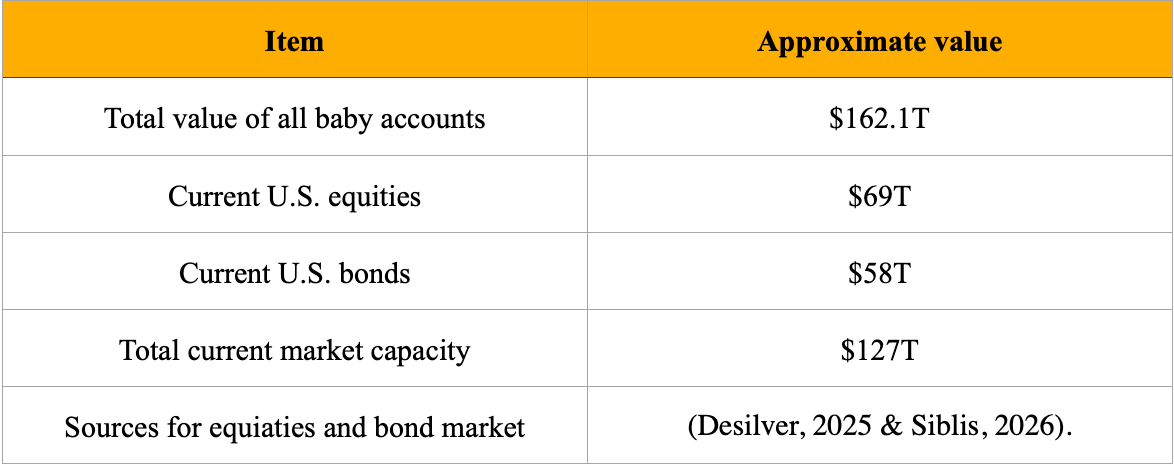
In other words, the scheme would require more financial assets than the country currently has—even before you consider wealth inequality pushing it higher. The taxpayer “cost” looked tiny (around $36B a year), but the market‑capacity cost was impossible.
That was my first big crack in the story I’d been told:
solutions that work for a household can completely fall apart at the scale of an entire economy.
Covid, Paychecks, and Family Stories
Fast‑forward to 2020. Covid hits, inflation spikes, and suddenly everyone is talking about the Consumer Price Index again. On paper, the U.S. economy looked strong. In reality, I was a single guy making $50–60,000 a year—and it still felt hard to pay rent and buy groceries.
That’s not a poverty income. By the official metrics, I should have been comfortable. But my monthly budget said otherwise.
So I did what economists rarely do: I asked my family.
My mom raised us after a divorce when I was four. She remembered things being tight, but she could still afford a place to live and food on the table. When we compared her realities to mine, her sense was: it’s harder now, not easier.
My grandparents painted an even starker picture. Housing and food were a fraction of today’s cost relative to income. Their stories about rent, groceries, and raising kids didn’t match the “we’re richer than ever” narrative.
At my wife’s grandmother’s funeral, her family reminisced about always having enough food for whoever dropped by. Extra mouths at dinner weren’t a crisis. Today, that kind of casual hospitality feels almost impossible.
Those conversations drove home a simple point:
The “measured” economy and the “felt” economy were drifting apart. Whatever the CPI and GDP charts were saying, ordinary people’s lived experience wasn’t lining up.
Shadow Stats, Rounding Errors, and a Suspicion
Around then, I stumbled across a George Gammon video on Shadow Stats and alternative inflation measures, claiming real inflation was 15–20%, not the official 8–9%. That felt too extreme to be the whole story—but it did raise a fair question:
If the index itself is off, what does “inflation‑adjusted” even mean?
I started playing with CPI data. One of the first things I checked was boring but important: rounding. By looking at a few years of CPI changes and how they’re reported, I found that simple rounding conventions alone could move the final annual number by as much as 0.5 percentage points in some cases.That’s before touching anything controversial—no hedonic adjustments, no basket substitutions, just the mechanics of how the index is computed and reported. It didn’t prove a conspiracy. But it did prove this: We treat CPI as a precise scalpel; in reality, it can behave more like a blunt instrument.
Once I stopped taking the official index as gospel, the door was open to a much deeper question.
The Human‑Time Realization
While I was exploring inflation, I also started making videos on a more basic question:
Why do we use money at all?
That trail led me straight into the heart of what eventually became NETs. Somewhere between explaining barter, trade, and why dollars circulate, it hit me: Without human time—our hours of work, creativity, and consumption—the economy is worthless.
No matter what you believe about “backing”—gold, government, military power—the only reason any currency has value is because millions of humans are willing and able to trade their time and output for it.
Factories, servers, robots, and algorithms all exist because of past human time. They only matter because they amplify what we can do with the next 24 hours.
I started to see the entire economy as: Human time applied to land and resources.
Once you adopt that lens, certain things stop making sense:
If productivity keeps rising, why aren’t essentials obviously cheaper in real terms?
If human time is the real engine, why do our measurements make it seem as if individual households are falling behind even as total output explodes?
That’s where the Novack Equilibrium Theory (NETs) began:
as an attempt to build a framework where human time is the anchor, and our data finally matches what people feel in their bones.
In the next essays, I’ll walk through how that journey led to a specific claim—that CPI has been understating inflation by about 1.5 percentage points a year—and why that small, persistent error quietly explains so many of the paradoxes we’ve been living through.
Next: If this is where the contradiction started, the next piece names it directly: read "A Warped Economy Does Not Announce Itself. It Just Makes Tuesday a Little Harder Every Year"
References:
Ward, M. (December 4, 2020). Billionaire investor Bill Ackman says the US should give every American cash at birth so they can retire a millionaire. Retrieved from https://www.businessinsider.com/bill-ackman-give-americans-cash-birth-universal-basic-income-equity-2020-12#:~:text=Ackman%20wrote%20that%20at%20historical%20rates%20of,benefited%20the%20rich%20and%20the%20upper%2Dmiddle%20class.
Siblis Research (January 1, 2026). Total Market Value of the U.S. Stock Market. Retrieved from https://siblisresearch.com/data/us-stock-market-value/
Desilver, D. (August 12, 2025). What to know about the bound market. Retrieved from https://www.pewresearch.org/short-reads/2025/08/12/what-to-know-about-the-bond-market/
United States Census Bureau, (February 12, 2025) 2023 National Population Projections Tables: Main Series. Retrieved from https://www.census.gov/data/tables/2023/demo/popproj/2023-summary-tables.html
Author: Kyle Novack
March 8, 2026
A Monumental Venture, LLC: research project (Novack Equilibrium Theory – NETs)
Attribution Required: © 2025–2026 Kyle Novack / Monumental Venture, LLC. For educational use with credit; commercial use requires permission. Full details in linked PDFs.