

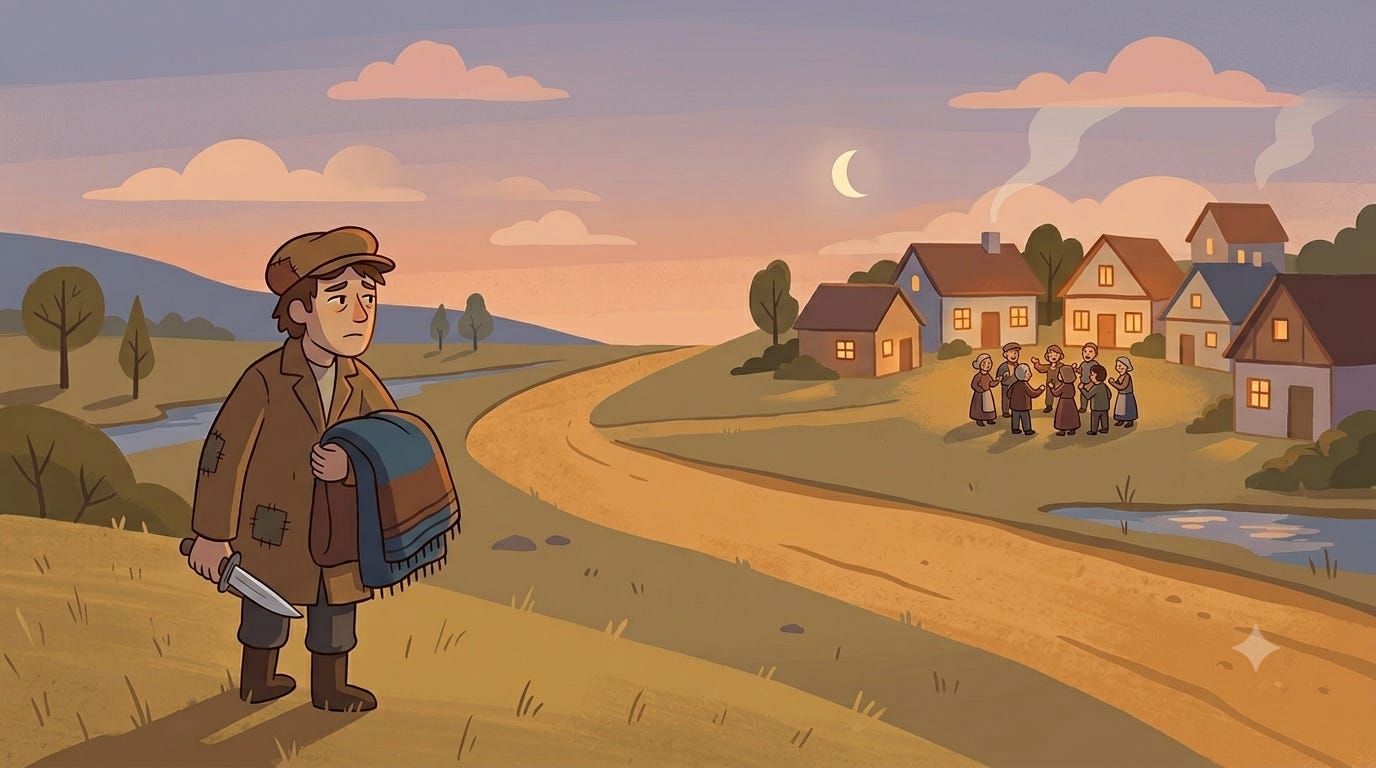
Imagine you are hungry, and you have no money. None at all. What you have is a knife, a blanket, and a few hours of daylight left in a town where nobody knows your name.
You could find someone willing to take the knife off your hands in exchange for food. But you already know the problem: everyone has a knife. Yours is not special, so there is no reason for this person to want it. You can feel the imbalance before you even open your mouth. They do not need a knife. They already have one. What you are really asking is for them to give you something you need in exchange for something they do not. It is less a trade than an act of good faith. You walk away with less than you gave, not because anyone cheated you, but because the person standing in front of you happened not to need the one thing you had.
Or you could ask for help outright, and hope someone is generous enough to feed you without anything in return. This does happen. But it is not something you can count on, and it is not something you could build a life around. The stranger giving you that food already knows they are unlikely to get anything in return. They have no reason to trust that you will ever be able to return the favor, and you have no way to prove that you would. It is not a trade. It is a gift.
Neither option depends on what you have to offer. It depends on whether anyone in that town has a reason to trust you.
In a town where people knew you, that reason would exist, and it would change everything. The person with food might say: I do not need a knife, but bring me firewood tomorrow and I will feed your family tonight. Or: come help with the harvest this week, and you will eat until it is done. The trade still happens. It is just deferred a day, because they know where to find you, and you know you cannot disappear.
Or the food might come with no terms attached at all, and it would not feel like charity to either of you. People do not like carrying an unpaid debt, nor being the kind of neighbor who never returns a favor. So the giving and the remembering become the same act. You feed me tonight. I remember it. The next time you are the one who needs something, and I have it, I give it, and neither of us ever must write any of it down.
None of that requires money. It requires knowing each other. And in a town full of strangers, the one thing that makes any of it work is the one thing you do not have.
That is the problem money was formed to solve. There was no single moment where money was invented, the way you might invent a tool and write down the date. It took shape the way clay takes shape: soft and shifting at first, then worked and fired under pressure until it hardened into something that could hold weight it never could have held on its own. Humans needed something whose worth would not collapse the moment you stepped outside the circle of people who already knew you.
Let us walk through that process: how we as humans came to a social agreement to use money as a substitute for trusting each other directly. Money did not get rid of trust. It moved it. You no longer needed to trust the specific stranger standing in front of you, what they were capable of, or whether they would ever repay you. You only needed to trust the money itself: that it would still hold its value the next time you went to spend it. That single shift, trusting a token instead of a person, is what made exchange possible between total strangers, at any distance, with no shared history at all.
This article begins to answer the question of what money is supposed to hold. The rest of this series follows that question all the way to what happens when money quietly stops holding it.
The World Before Exchange
Before any money existed to replace trust, there was only the circle of people who already knew you, and it is worth understanding exactly how that circle worked before we trace what came after it.
For most of human prehistory, the communities humans lived in were small enough that everyone knew everyone. A village of fifty or a hundred people is not an abstraction. It is your family, your neighbors, the person who helped you when your roof collapsed and the person whose child you watched when they were sick. You knew who pulled their weight and who did not. You remembered.
In that kind of community, formal exchange was not necessary. If you had extra food and your neighbor was hungry, you shared it. Not because of a law, not because of a contract, but because you would need them someday, and because letting a neighbor starve while you had surplus was the kind of thing people remembered. Anthropologist David Graeber spent years studying this question across pre-market societies, and he argued that the basic unit of early human economic life was not barter. It was obligation: the quiet understanding that if you needed grain and your neighbor had it, he gave it to you, and you owed him one. No price. No receipt. Just a social bond that tracked the exchange and expected eventual balance (1).
You do not need ancient records to see this mechanism still working. It runs on the same logic as the boy who cried wolf: no formal punishment, no verdict, no contract violated. Just a village that quietly stops listening once it has learned what your word is worth. Reciprocity works the same way, except it tracks actions instead of words. Watch any small town today. Nobody hands you a contract when they help you move a couch or watch your kids for an afternoon. But the people who never return the favor quickly find that the offers stop coming. Nobody announces it. Nobody accuses them of anything. People just quietly start giving their time and their extra to someone else instead, someone who has shown they will do the same when it is their turn.
This system has merit because the community was small enough to make it work. Trust was based on personal knowledge. Reputation was the enforcement mechanism.
Then communities grew.
Where The Honor System Broke
Scale is the enemy of informal systems. When a community grows from fifty people to five hundred, and then to five thousand, the personal knowledge that made reciprocity enforceable begins to dissolve. You are no longer dealing with your neighbors. You are dealing with strangers. And strangers have no reason to trust that you will reciprocate, and you have no reason to trust them either.
At the same time, something else was happening. As communities grew, individuals began to specialize. Adam Smith made this case in 1776 in The Wealth of Nations, in what became the most famous illustration of the idea: he wrote that he had seen a small pin factory where ten workers, each handling one step of the process, produced upward of 48,000 pins a day, compared to perhaps 20, or even one, if a single worker tried to do every step alone. The specific figures are Smith’s own account rather than an independently verified study, but the underlying mechanism, that specialization multiplies output, is one of the most well-established findings in economics, with two and a half centuries of subsequent evidence behind it. When one person spends their whole life farming, and another spends their whole life making tools, both become dramatically better at what they do than either could manage alone. Specialization multiplies output. It raises living standards for everyone (2).
But it comes with one large caveat. The more specialized a person becomes, the less capable they are of providing for themselves. A skilled potter who spends his life perfecting clay has no time left to learn farming, and a farmer who has spent decades mastering soil and season has no time left to learn pottery. Specialization does not just raise output. It strips away self-sufficiency, and it replaces it with dependence on everyone else doing their part, too.
The farmer who grows food all day does not make clothes. The blacksmith who makes tools all day does not grow food. Every specialist needs what every other specialist produces, and none of them can supply their own needs. The honor system that worked in a small village cannot operate across hundreds of strangers with no shared history and no mechanism for tracking who owes what to whom. It breaks under the weight of its own scale.
The village was a community. The city is a network. Communities run on trust. Networks need something else.
Why Barter Could Never Have Worked Alone
The textbook version of this story tends to imply a clean sequence: barter first, with money arriving later to fix it. Nobody has direct records of prehistoric exchange, so no version of this story, including the one this article leans toward, can be proven outright. What does exist is ethnographic studies of societies anthropologists could observe, and that evidence consistently fails to turn up anything resembling a dominant, standalone barter economy. Cambridge anthropologist Caroline Humphrey, after reviewing the available ethnography, concluded that no pure barter economy has ever been documented (3).
What shows up again and again is obligation, early commodity standards like cattle and shells, and accounting systems that predate anything resembling formal coinage. That does not mean direct trade never occurred between two people who each had what the other wanted. It means direct trade and these early stand-ins for money appear to have run alongside each other for a long stretch of history, not as two sequential stages but as two tools people reached for depending on what the moment required. If a workable trade was sitting right in front of you, you took it, because handing over something as valuable as a cow for a transaction you could settle directly was a poor use of it (4).
The reason Barter was probably never a standalone form of exchange is that it has a major issue. Barter requires what economists call a double coincidence of wants. You have bread. I have eggs. For a trade to happen, I need to want bread at exactly the moment you need eggs, in quantities that we both consider fair. That works occasionally. But what happens when the person who has what you need does not need what you have?
Think through a simple chain. You need drinking glasses. The potter will trade glasses for pants. The tailor will trade pants for kitchen pans. Your neighbor will trade pans for a chair you happen to own. So you trade the chair for pans, the pans for pants, the pants for glasses. Four transactions to get one household item, each one requiring you to find the right person at the right time with the right need.
Now scale that to an entire economy. Now add the carpenter, who earns his living by performing a service rather than producing a single physical good he can hand over outright. He spends five hours repairing a neighbor’s wagon wheel. In exchange, he receives ten loaves of bread and six dozen eggs, because that is what the homeowner had available and what they agreed was fair. The carpenter cannot eat ten loaves of bread before they go stale. So now he needs to trade the bread and eggs for everything else he needs, which requires finding people who want bread and eggs and have what he needs, which requires time he could have spent doing the work he is good at.
Barter does not scale, and the carpenter shows exactly why, even once trust is not the issue at all. He and the homeowner agree the trade is fair. The wheel gets fixed. The bread and eggs change hands. Nobody is cheated, and nobody distrusts anyone. But none of that helps the carpenter get what he needs to survive past that one transaction. That failure is the real story here, more than whichever side of the barter-versus-obligation debate eventually turns out to be right. Whether early trade ran mostly on cattle and shells, mostly on remembered favors, or some mix of both depending on the moment, the trust problem and the double coincidence of wants are not the same thing. Trust gets you a single fair trade. Nothing about a single fair trade tells you how to turn what you received into everything else your life requires.
Notice what went wrong for the carpenter. He did real work, and the homeowner walked away better off because of it. That much worked fine, since the homeowner needed a wheel fixed and had bread and eggs on hand, and the trade made sense to both in that moment. The problem started the second the carpenter tried to go anywhere else. The baker has no use for someone else’s leftover bread and eggs. He did not get a wheel fixed. He gets handed food that means nothing to him beyond whatever he could personally eat or trade away himself, and he has every reason to treat it that way. The payment the carpenter walked away with was real to the one person who needed exactly what he offered. It stopped being worth anything the moment he carried it to someone who did not.
The problem money needed to solve was not inefficiency in barter. It was something deeper: how do you extend the trust and obligation of the small community outward, into a world of strangers, across distances and time, without the personal knowledge that made the system work? Money itself is neither trust nor an obligation. It is a mechanism for proving, instantly and to a total stranger, that you can hold up your end of an exchange, without either of you needing to know anything else about the other person. The community used to verify that through memory. Money verifies it through possession of the token itself. But the token only works because of what stands behind it. The thing that gave money value in the first place was always the value being exchanged, the goods, the labor, the effort, not the token itself.
For that token to work, it needed two things at once. Anyone holding it had to trust that it would still hold its value the next time they spent it. And it had to be exchangeable for almost anything, not just bread, not just a fixed wheel, but whatever a person needed, as long as a price could be put on it. That is what money was built to do. Once both of those things were true, the carpenter no longer needed to find someone who happened to want eggs and happened to have what he needed. He needed a price and a willing buyer, nothing more. That single change took the friction out of every trade that followed.
What money was actually built to prove
What the agreement is tracking is human time, not effort or output. That distinction matters more than it sounds like it should. A person does not have to produce anything to add value to an economy. The moment someone exists, they need things: food, clothing, shelter, care. That need is demand, and demand is real economic activity, the same kind of activity that shows up when someone works and produces something to sell. An infant who has never worked a single hour still drives the production of formula, diapers, and clothing. A retiree who no longer works still drives demand for everything they buy. Value, at the level of the whole economy, comes from both sides of every exchange, the producing and the consuming, not from production alone.
This does not mean a person is owed anything simply for existing. Existing creates potential: the possibility of contributing labor, and the certainty of generating some demand. At the level of the whole economy, that potential is what keeps the system’s measurements stable as a population grows. But potential is not a paycheck. Turning it into an actual claim on the economy still requires either doing work someone else values enough to pay for, or being cared for by someone who will, a parent, a family, a community, in their place.
This is part of what money has always quietly done. It lets you prove, to a total stranger, that you already did your part, without ever having to say it out loud. Handing over money is not just a transaction. It is a kind of proof. It says, silently, that at some point you gave someone else something they valued enough to pay you for it, and that whatever you are about to receive in return is honestly earned, not assumed. The baker does not need to know the carpenter’s name or remember a single favor between them, because the money already carries that proof. If the carpenter had never created value for anyone, there would be nothing to hand over, no money to spend, and no way to ask the baker to simply take his word for it.
Survival has never been the economy’s default setting. It has always required one of two things: being taken care of, or doing the work to take care of yourself. Money, at its foundation, is the record of which one happened, and between whom, made portable enough to work between total strangers who will never know each other’s names.
That is what money was built to solve. That is the problem it was designed for.
And here is the question that the rest of this series will follow. Human time cannot be handed from one person to another the way bread or a repaired wheel can. It has no physical form. You cannot touch it, store it, or pass it across a table. But it shapes the physical world completely, every object, every service, everything anyone has ever paid for. Money exists because something had to stand in for time’s place, a physical, transferable substitute for something that could never be transferred on its own. So here is the real question. If that is what money was always meant to be a substitute for, the total time and need of every person participating in the economy, what happens when the substitute drifts away from the thing it was standing in for? What happens when the token stops being a faithful substitute for the time and the people it was built to represent?
Sources
1. Graeber, D. (2011). Debt: The first 5,000 years. Melville House.
2. Smith, A. (1776). An inquiry into the nature and causes of the wealth of nations. W. Strahan and T. Cadell.
3. Humphrey, C. (1985). Barter and economic disintegration. Man, 20(1), 48–72. https://doi.org/10.2307/2802221
4. Hogendorn, J., & Johnson, M. (1986). The shell money of the slave trade. Cambridge University Press.
Author: Kyle Novack
June 23, 2026
A Monumental Venture, LLC: research project (Novack Equilibrium Theory – NETs)
Attribution Required: © 2025–2026 Kyle Novack / Monumental Venture, LLC. For educational use with credit; commercial use requires permission. Full details in linked PDFs.