

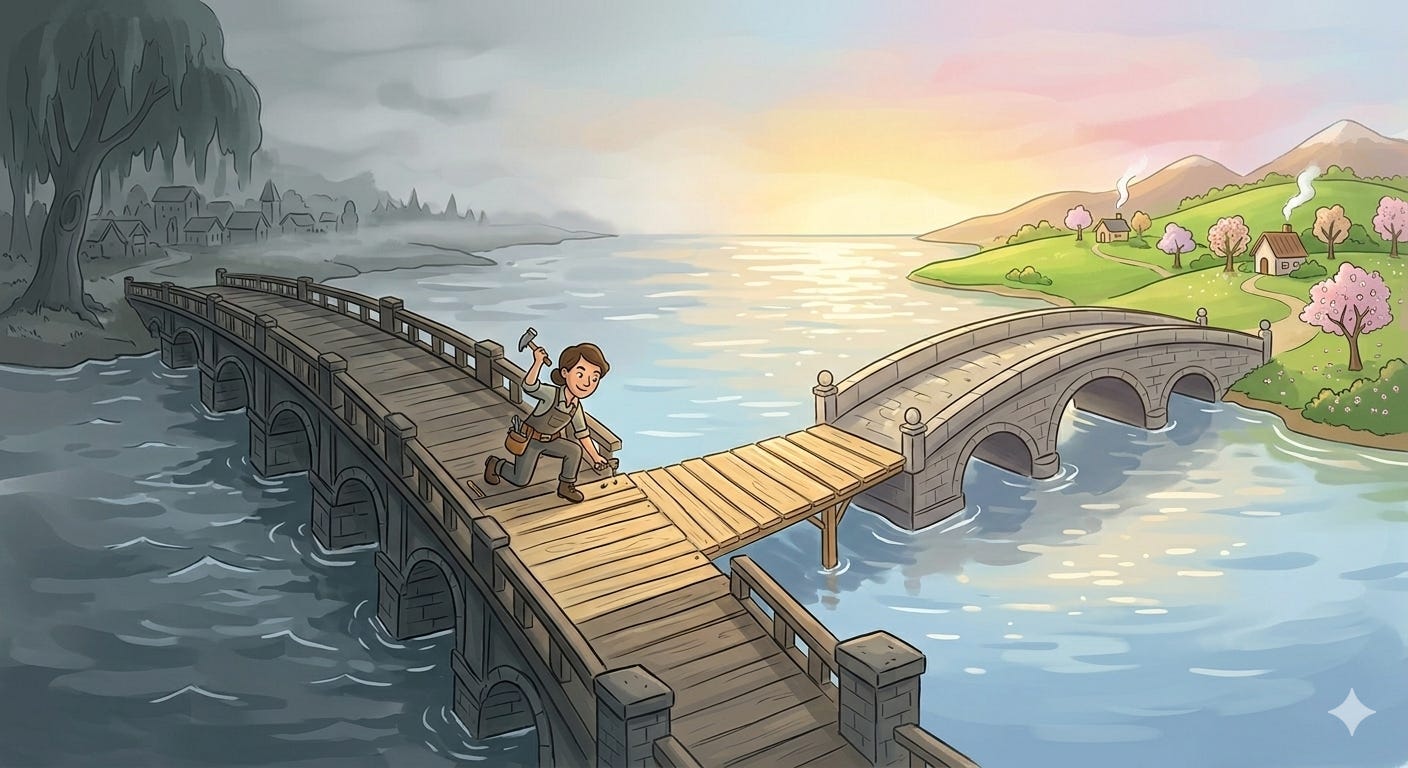
Building something from scratch is hard in ways that are difficult to see from the outside. But building is not the same as building right. And the difference between the two is not always visible until you are already deep into the structure.
In the last piece, I gave you the framework. Know your shore. Protect it while you build. The plan is allowed to change. The shore is the commitment.
That is simple enough to understand. What is harder to communicate is what it costs when you do not.
Because the cost is not always a career you did not want or a business that did not work. Sometimes it is a relationship you stayed in too long because the timing never felt right to leave. Sometimes it is a window that closes while you are still deciding which bridge to walk across. Sometimes it is something that cannot be rebuilt at any price once it is gone.
That is what this piece is about. The following are not hypotheticals. They are two people who built real things, made real sacrifices, and still ended up somewhere they never chose. These are real examples of what can happen when you never fully consider what you are building toward, even when you think you have.
The Shore That Was Never Hers
Ashley Butler had everything she was supposed to want.
She was a physician. Then the founder and CEO of a seven-figure service business that people in her industry were calling the next billion-dollar brand. By every visible measure, she had built a life worth having not once but twice. The credentials. The income. The kind of resume that makes other people feel behind.
And underneath all of it, quietly, a voice that kept saying: this isn’t it.
She became a doctor because she believed it would bring happiness and fulfillment. And as she told me directly, the rational mind can convince us of so much. The logic was sound. Medicine meant security. Security meant safety. Safety meant enough. She heard the whisper that something was wrong and kept building anyway, because the shore she was heading toward looked right from every angle she had been taught to look from.
So when medicine did not deliver what she had been promised, she did what driven people do. She built something else. A business. Her own terms. Her own time. Something with purpose behind it rather than just a credential. That was closer. But it still was not right.
That feeling started to return for her that something was off again until it got so strong that she could not ignore it. For a while, she disappeared. Not because she was broken. But because for the first time in her adult life, she had no title to hide behind. No career. No company.
And for the people around her, the ones who had watched her build all of it, it looked like she had everything and threw it away. They were not wrong about what she had. They were just measuring it the way she had been taught to measure it, too.
That social pressure was brutal and could have been enough to revert her back to the old life, but she kept one question in focus:
Who am I when I stop chasing everyone else’s version of success?
She is still answering that question out loud, in public, at Not Sorry. The resolution is not the point of telling her story here. The point is what it cost her to finally stop and ask whose destination it was in the first place.
The inner voice was there the whole time. She just did not listen. Most of us do not.
Some people never hear the voice at all. Others hear it and cannot move. Ashley heard it, moved fast, and built again before she had finished asking the question. The second build was closer. But it was still not hers.
In contrast, there is another failure mode that Alicia experiences. She knew exactly what she was escaping, yet still ended up somewhere uncomfortably familiar.
The Prison She Built Herself
Alicia Teltz, founder of The Hype Department, did not drift into the wrong life. She blew hers up deliberately as she came to the same realization as Ashley: this cannot be all that life is.
Thirteen years into an accidental corporate career, having worked her way from a twelve-bed hostel room in London to a Global Client Executive role at LinkedIn, she stopped on her 34th birthday and asked the question most people never ask out loud: is this it? Is this what I am doing for the next thirty years?
The answer was no. Over the next two years, she made the kind of decisions that most people talk about and never make. She ended a nine-year relationship. Sold the house. Sold the car. Moved into a studio flat. And eventually quit LinkedIn to build her own business, a business about LinkedIn of all things. She was aware of the irony.
What she built was real. The audience grew. The income came. By the measures that matter in the early stages of building something new, it was working.
And then she looked up from her laptop.
Ten hours a day. Seven days a week. Client deliveries stacked on top of client deliveries. The calendar that was supposed to belong to her was, once again, belonging to everyone else. She had left a corporate job that owned her time and built a business that owned it instead. Different building. Same prison.
She named it herself: she had become a prisoner to the business that was supposed to liberate her.
She knew what she was trying to escape when she started building. She just did not build the guardrails in fast enough to stop the construction from becoming the thing she left.
The Off-Ramp, Not the Leap
If either of those stories landed closer to home than you expected, here is the part that matters most.
Both Ashley and Alicia made dramatic changes. Ashley walked away from medicine and then from a seven-figure business. Alicia ended a nine-year relationship, sold the house, and quit a senior role at one of the world’s most recognizable companies. Those are not small moves. But neither of them burned the bridge on the way out. The exits were deliberate. The professional relationships held. The credibility carried over. And that is precisely what gave them the foundation to build what came next.
What they did not do was react. They did not quit in a moment of frustration, blow up the professional relationships, and start from zero with nothing to stand on. The difference between blowing up your life on your own terms and blowing it up reactively is not always visible from the outside. But it is everything on the inside.
Jumping off a bridge looks dramatic and decisive. It is also a good way to end up in the water with no bridge and no new shore in sight. Quitting everything at once in a single moment of frustration, burning the professional relationships and the income and the infrastructure before you have anything to step onto, almost never leads where you hope it will.
What you build instead is an off-ramp.
An off-ramp looks like this: you keep walking the current bridge while you start laying the first planks of a connector. One small step toward the new direction, while still moving forward on the existing one. You do not stop. You do not leap. You build a path between where you are and where you are going, one plank at a time, until the connector is solid enough to step onto.
This is slower than jumping. It is also the approach that actually works. Because by the time you are fully on the new bridge, you have not destroyed the old one. You have just stopped needing it.
The off-ramp is always intentional. It is what a shore change looks like when it is done deliberately rather than reactively. For Ashley, the off-ramp pointed toward an entirely different shore. For Alicia, it was a course correction toward a different spot on the same shore. Both were valid. What made them work was not the direction. It was the intention behind it.
The off-ramp also gives you something the leap does not: time to discover whether the new bridge is actually what you thought it was. You get to test the direction before you are fully committed to it. You get to learn while still having something to stand on.
Where I Am on This, Right Now
This is not something I am viewing from the sidelines. It is the exact position I am standing in.
I told you in Part 1 of the series that I am still on the incline of the bridge. That is still true, but as always, there is more to the story.
This arc did not start recently. It started over ten years ago, long before the NETs project existed, long before I could have named any of this clearly. Looking back honestly, none of it was wasted. The jobs I did not want taught me what I was not willing to tolerate. The work that drained me taught me what sovereignty actually means to me. You cannot see the foundation clearly until you know what you are building on top of it, and you cannot know what you are building on top of it until you have done enough living to have something to reflect on.
I am already thinking about what the business side of this work will look like as it grows. And I know, clearly, that if I am not deliberate about how I build it, it could very easily become the thing I am most trying to protect against: a structure that owns my time instead of one that I own.
My covenant is not complicated. It has two things in it.
The first is time sovereignty: the ability to do this work, the NETs framework, the writing, the thinking, without having to ask permission for my own hours. Not infinite free time. Just the structure where my intellectual work happens on my terms.
The second is presence: being with my daughter and my wife when I choose to be, not when a schedule allows a gap. Being a father and a husband first, with the work built around that, not the other way around.
Those two things are my shore. Everything I am building right now gets tested against them. And the fact that I can name them clearly, right now, while I am still in the early stretch of the bridge, means I can start building the protection into the structure from the beginning, rather than trying to retrofit it later when it is harder to change.
What I am trying to do is thread the needle. Build something impactful enough to matter, while protecting the things that matter most to me. In Part 2, we reference the fisherman parable, where he had already found that balance without needing to plan for retirement. I am trying to build my way to it deliberately, with the covenant as the guardrail, while still on the incline and not yet knowing how it ends. Providing for the ones you love, while impacting those around you, is part of the point of life. Building something that allows you to do that into the future is some of the most important work you can do.
Most people treat retirement as the shore because they have never figured out how to integrate work into the life they actually want. When your work is fulfilling and built around your covenant, that equation changes. You do not need to plan for a retirement. The work just becomes part of who you are.
The Cost of Waiting Goes Up Every Year
That is the advantage of doing this work early. The further along you are, the more you have built, the more expensive it becomes to redesign the structure. Not just monetary loss, but the emotional toll of time that passed and phases of life that cannot be returned to. The person who sets their covenant at the beginning has options; the person who sets it at year five does not. But setting it at year five is still better than never setting it at all.
That is true for Ashley and Alicia too. The years they spent building the wrong thing were not wasted either. They were the stepping stones that made the next build possible. Alicia has already done what the off-ramp section describes: she recognized the misalignment, rebuilt the plan, and kept moving. She is not stuck. She is building again, this time with the guardrails more clearly in mind.
And notice something about all three of these stories. None of us are saying we are too important to work or that work is the enemy. The covenant is not about doing less. It is about making sure the work serves the life you are building rather than replacing it. The balance between contributing something meaningful and protecting the things that matter most to you is not a luxury. It is the point.
If you do not know your covenant yet, the answer is not to wait until you do. Move forward. Take the opportunities that present themselves. Build something. The self-reflection that eventually names your shore needs lived experience to work with. And at some point, if you are honest with yourself, the pattern will reveal itself and you will finally have the context to name what you were always building toward.
The Covenant Is Yours Alone
I want to be honest about something before I close this.
None of this is a formula. I cannot tell you what your right destination is. I cannot tell you whether the bridge you are on is the correct one for you. I cannot look at your life from the outside and give you the answer to the question this whole piece is built around.
What I can tell you is that the people who do this work, who actually sit with the destination question rather than skipping past it into tactics, who write the covenant before the construction begins, who protect the shore as they build: those people make better decisions. Not perfect decisions. Better ones. Because they are not just working off instinct anymore. They have done the thinking. Every step gets tested against something real.
And there is a meaningful psychological difference between grinding and building. Grinding is doing what needs doing. Building is doing the next right step toward somewhere you have decided to go. Both can look identical from the outside. But the person who is building has something the person who is grinding does not: a reason that holds up when the walk gets long, and the shore is still invisible.
Your destination is allowed to evolve. If you do all this work and set your shore clearly, and then five years from now your priorities have shifted, you have not failed. You have grown. The covenant is a living document. The point is not to lock yourself into a permanent answer. The point is to stop sleepwalking, to make choices instead of defaults, to know the difference between changing your mind and losing your way.
Most of this is gray. Anyone who tells you it is black and white is either selling something or has not thought about it long enough.
The guardrails make it easier. But Ashley and Alicia both prove that it is possible to build, recognize the misalignment, pull back, and move forward again toward a shore that actually fits. For most people, that is the process. The covenant does not guarantee a straight line. It just means you are less likely to lose something irreplaceable before you find your way back.
Figure out your shore. Build the guardrails in as you go. Keep coming back to make sure they still hold. And always keep building.
One last thing before you go.
Most of what I publish here is not about building a personal life. It is about fixing the structural conditions that make building one harder than it should be, specifically a measurement problem in how we track inflation that has been quietly compounding for over a century, and what it means for every family trying to get ahead.
The two are not separate projects. They are the same project at different scales.
The Bridge series is about the personal covenant: what to build, how to protect it, and how to make sure the life you are constructing is the one you chose. The NETs project is the same work applied to the economy itself. There are things about the economy we intuitively know to be true. That humans are the driver and the beneficiary of all of it. The point of the work is not bigger businesses or better technology, but better lives for the people around us. That truth has been getting harder to see because a structural problem in how we measure inflation has been quietly skewing the data toward incorrect conclusions. That problem is measurable. It has never been explained clearly enough to fix. That is what the economics work is about: diagnosing where the economy went wrong, identifying what matters, and building in the guardrails that ensure the system produces accurate outcomes for the individuals who make up the economy, not just accurate numbers.
The economic work also explains why most families are not failing due to not working hard enough. The measurement system they have been handed to navigate by has been quietly off for over a century. That is not an abstract problem. It shapes every wage negotiation, every housing decision, every retirement calculation, every moment where someone does everything right and still cannot close the gap. That is what the rest of this publication is about.
If you found the economics first, thank you for following me here. If you found this first, welcome. Everything ahead connects directly to what this series has been building toward.
P.S. This piece would not be what it is without Ashley and Alicia sharing their stories openly and honestly. If their work resonates with you, please support them. Ashley writes at Not Sorry and Alicia writes at The Hype Department. Both are worth your time.
If you have not yet read the empirical case behind this work, it starts at “How I Realized the Numbers Were Lying to Us.”
Author: Kyle Novack
June 12th, 2026
A Monumental Venture, LLC: research project (Novack Equilibrium Theory – NETs)
Attribution Required: © 2025–2026 Kyle Novack / Monumental Venture, LLC. For educational use with credit; commercial use requires permission. Full details in linked PDFs.
Thank you Kyle for such an awesome piece. And for including a bit of my story in it too! 💜
Alicia’s adds an additional layer to your words that really make this thing hit home.
Excited to see you keep working through and sharing these ideas with all of us.
Thank you so much for featuring me in your piece. I looove how deeply you dive into the question of how to make sure the life you are building is the one you chose! 🧡🙏🏻