

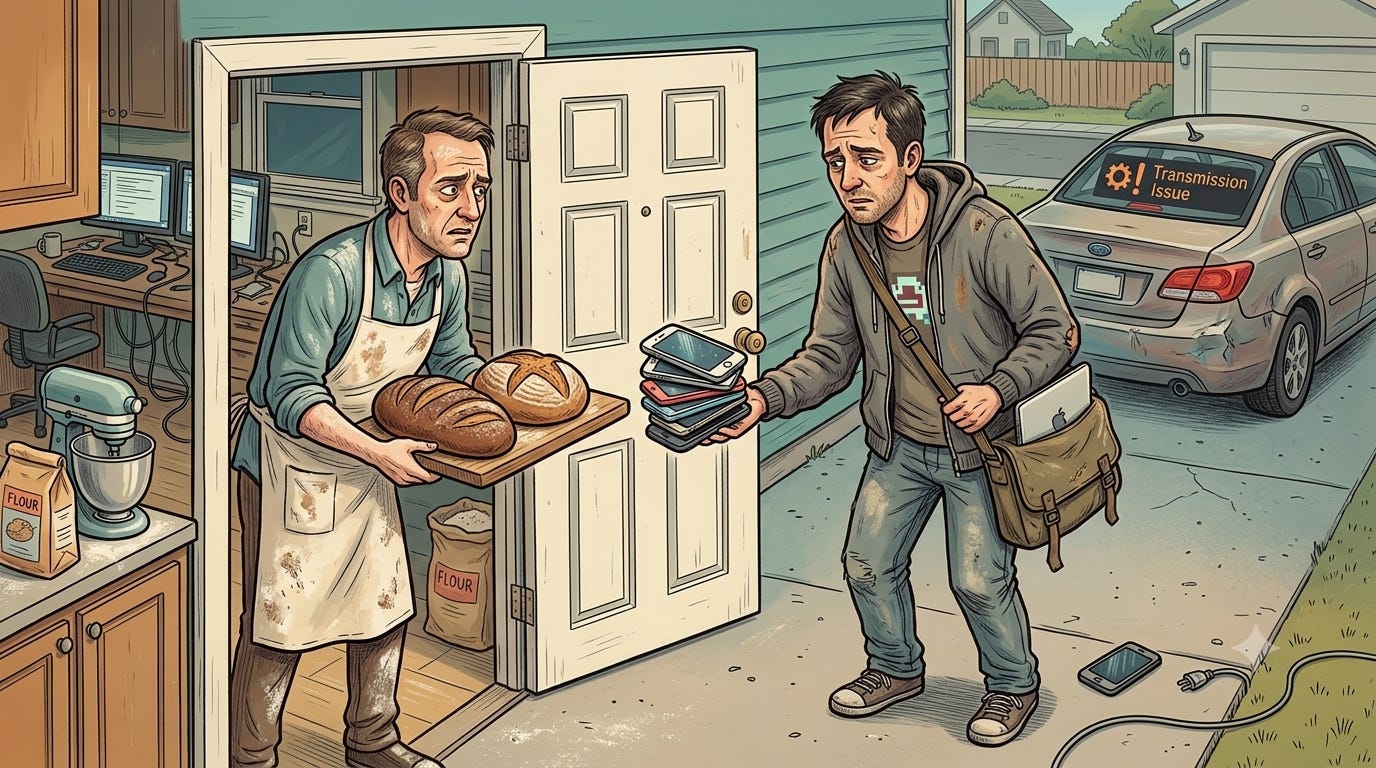
Thomas and Eleanor had it simple. Two people, two goods, one exchange they could both see and understand. That simplicity does not scale. Somewhere between a village of two hundred and an economy of three hundred million people, the direct link between effort and exchange breaks down completely. Here is what that breakdown looks like from the inside.
Marcus has spent 11 years writing code for one of the world’s most valuable companies. He works on the camera system inside the iPhone. Not the whole camera. The low-light processing algorithm that decides, in a fraction of a second, how to handle the shadows in a photograph taken in a dim restaurant. That is his job. He is extraordinarily good at it. He has spent over a decade becoming extraordinarily good at it, and the economy rewards him well for that specialization.
In our economy, that reward arrives as money. He deposits a paycheck, pays his bills, buys his groceries, and the specialization works in his favor. The system is invisible because it functions.
Now remove the money. The work stays the same. The skills he has spent 11 years building remain his competitive advantage. The product is still an iPhone. Just the money is gone.
Apple still needs Marcus. The iPhone still needs his algorithm. He still shows up, still writes the code, still ships the feature. But instead of a paycheck, Apple pays him in product. Specifically, in the thing the company makes. At the end of every two weeks, Marcus receives his compensation in iPhones.
This is where the day begins to fall apart.
The Same Job, No Money
Marcus needs bread. His family goes through two loaves a week, which is not a complicated need. He finds a bakery willing to trade. After some discussion, the baker and Marcus agree that the iPhone is roughly equivalent to 250 loaves of bread, more than Marcus could use in over 2 years. However, the baker does not want to keep track of the trade for that long, so they agree to 25 loaves a week for 10 weeks. The baker only agrees to spread it out because he has known Marcus for years and trusts him to see it through. A stranger would not get this deal. Marcus is okay with this because now he has a lower valued item, bread that he can more easily trade for other things.
Marcus takes the deal. It feels like progress, since now he is not stuck holding one illiquid asset he must trade away in a single lump. But his family only eats two loaves a week. The other twenty-three sit there. Bread does not keep. He cannot store two years of bread in a kitchen built for a week’s worth, and he cannot eat his way through the surplus before it molds. He has not solved his problem. He has relocated it, from an iPhone that depreciates over a year to a loaf of bread that spoils in days. He still has not solved it when the next problem arrives. Marcus must figure out how to pay rent for the month.
What the Landlord Actually Wanted
His landlord is less interested in iPhones than the baker was. He already has three. What he needs is a new water heater for the unit downstairs. Marcus does the math. A water heater costs about half an iPhone. He asks the landlord directly. “If I get your water heater fixed, does that cover rent for the month?” The landlord agrees.
Marcus finds a plumber willing to install a water heater, but the plumber does not want an iPhone either. He wants materials he can use on other jobs, pipe fittings, solder, the kind of stock that keeps a business running. Marcus agrees to cover it. He goes to the hardware store and works out a bundle: the water heater itself, plus the plumbing supplies the plumber asked for, all for one iPhone total. The hardware store takes the deal.
The plumber installs the heater. The landlord marks the rent as paid. Marcus ends the month having covered a bill that normally costs two iPhones, for one. On paper, it looks like he came out ahead.
But look at what Marcus did to save himself an iPhone worth of value. A negotiation with the landlord. A search for a plumber willing to trade at all. A separate trip to a hardware store to bundle a heater and materials into a single deal that 3 different people had to agree to. This all took time, and Marcus had to coordinate every one of these trades himself. It cost him hours he could have spent with his family, working on his actual job, or working on his hobby.
What the Doctor Needed Instead
Marcus’s family also needs healthcare. The pediatrician’s office is willing to see his children, but the doctor himself has no use for phones. His waiting room already has a mounted display running on last year’s model. What he needs is a reliable car, since his current one has developed a transmission problem. After some talking, Marcus and the doctor agree that if Marcus gets the transmission fixed, the doctor will provide basic healthcare for his family for a year. Marcus does not know the doctor personally, but the office has served this town for years. Reputation is its own kind of collateral.
This creates an immediate problem. His daughter is sick and needs to be seen today, not whenever the transmission gets sorted. But he still has bread. He asks the doctor, “If I gave you 20 loaves of bread, would you be willing to see my daughter today? I will work on your transmission after.” The doctor agrees to the 20 loaves.
With his daughter seen, Marcus starts working the transmission problem. He finds someone willing to sell a transmission for 2 iPhones, paid on the spot. That covers the part. Then he starts calling mechanics to install it. He is having a hard time finding one who still needs an iPhone. In 2026, the pool of people without one is shrinking fast. He finally finds someone, and installation costs him 2 more iPhones, paid the moment the job is done. 4 iPhones total, spent immediately, no credit involved, and Marcus now has medical care covered for a full year.
What Kept Going Wrong
This is the double coincidence problem, and it does not announce itself as a theoretical concept. It arrives as a Wednesday afternoon spent calling strangers to find out if anyone needs a phone badly enough to give him something he can trade to someone else who has something closer to what he needs.
The problem compounds in a second direction. Marcus’s algorithm is not a physical object. He cannot hand it to anyone. What he produces is intangible, and the only way the economy compensates him for it is through the company that translates his intangible work into a physical product he can carry out of the building. Remove the money, and the entire translation layer collapses. He is only tradeable because Apple converts his labor into something with physical form. A plumber can at least hand someone a fixed pipe. Marcus can only hand someone a phone that someone else built, one that contains his contribution invisibly, buried inside millions of lines of code no one can see, separate, or divide.
By the end of the month, Marcus has spent more time arranging trades than writing code. He has fed his family, paid rent in full, and secured a year of healthcare for his children through the transmission deal. He is staying afloat, but only because he keeps finding people willing to negotiate. The only thing he has to trade is iPhones, and he knows their value drops the moment the next model ships. Whatever he does not spend or convert now is worth less later. Saving for anything beyond this month is nearly impossible.
He is exhausted in a way that has nothing to do with the work he was trained to do.
Three Hundred Million Marcuse’s
Now multiply Marcus by 300 million Americans. Each one trying to convert their narrow specialization into everything else they need, one trade at a time, through chains of coincidence that must align perfectly for anything to move. The engineer trading his code for an iPhone, and the iPhone for bread. The teacher trading lesson plans for a car repair. The nurse trading shift hours, somehow, for a mortgage payment.
The economy does not slow down under this system. It stops. Not dramatically, not all at once. It stops the way a machine stops when you remove the lubricant: gradually, then completely, one seized component at a time.
Due to the problems bartering created, we already know what happened next. We created another system, currency, a standardized unit of exchange that dramatically simplified trading goods and services between individuals. For Marcus, that means his 11 years of specialized expertise now earns him a paycheck. That paycheck trades cleanly for bread, rent, healthcare, and everything else, without requiring him to find someone who needed exactly what he had at exactly the moment he needed what they had.
That is what Part 3 is about.
But before we get there, it is worth sitting with what the collapse reveals. The barter system did not fail because Marcus’s work was not valuable. It failed because his value was too specific, too intangible, and too compressed into a product that could not be cleanly divided to cover the full range of what a human life requires.
The value was always there. The system just had no way to move it.
Author: Kyle Novack
July 7, 2026
A Monumental Venture, LLC: research project (Novack Equilibrium Theory – NETs)
Attribution Required: © 2025–2026 Kyle Novack / Monumental Venture, LLC. For educational use with credit; commercial use requires permission. Full details in linked PDFs.