

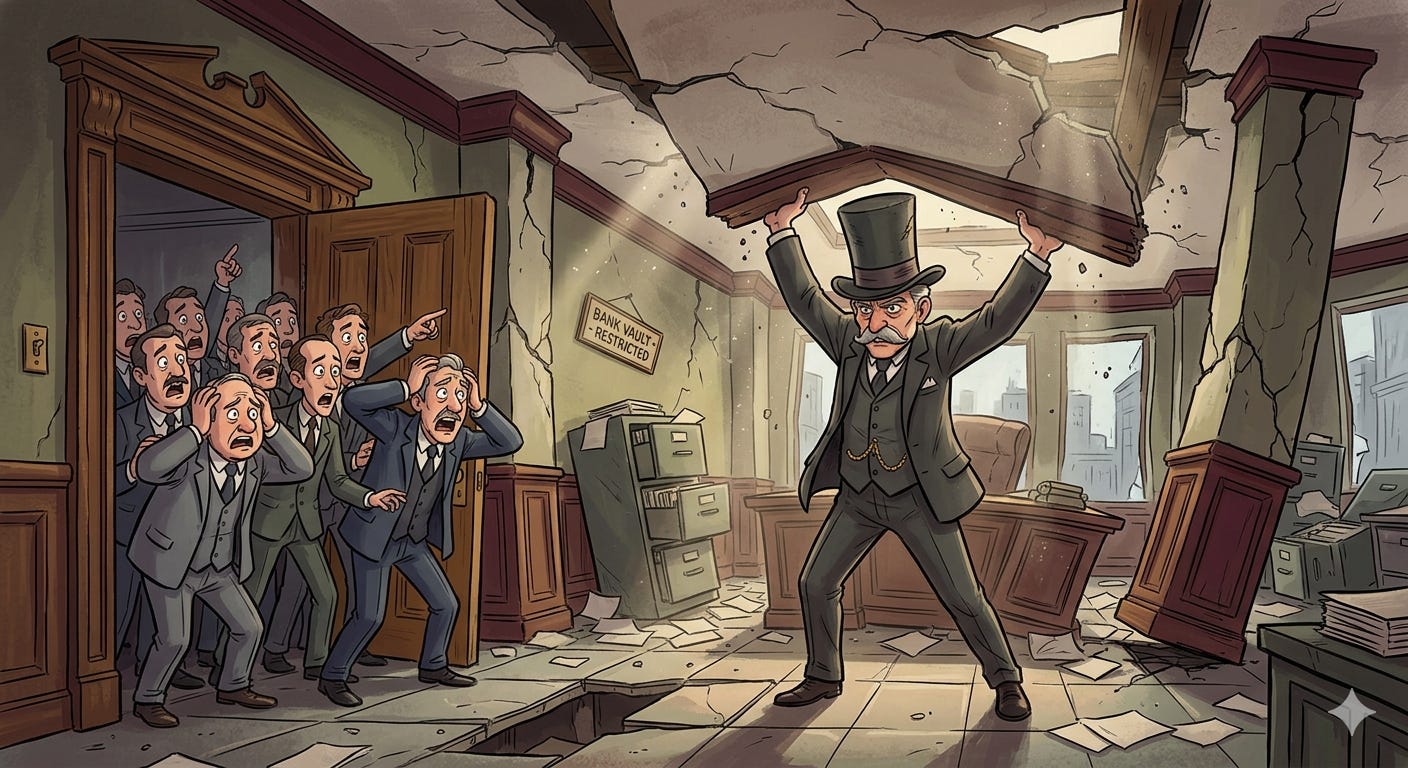
In the last part of this series, we traced the financial conditions that made one of the most significant events in American financial history inevitable. In 1873, a panic. In 1884, a panic. In 1890, another. By 1893, the system had deteriorated so severely that hundreds of banks collapsed, and the Treasury’s gold reserves fell so dangerously low that only a private bailout from Wall Street kept the United States government from defaulting on its obligations. Each crisis ran its full course because there was nothing in place to stop it. By the autumn of 1907, the system had run out of chances. That is exactly where we pick up.
On the evening of October 22, 1907, a line of depositors formed outside the Knickerbocker Trust Company in New York City. By the next morning, the line stretched down the block. By midday, the Knickerbocker had suspended payments. The run spread almost immediately to the Trust Company of America, then to Lincoln Trust. Across the country, credit markets seized. The New York Stock Exchange nearly closed. Cities that had borrowed to build water systems and schools found themselves unable to access the capital markets to make payroll. The entire financial system of the United States was teetering on the edge of collapse (1).
To make matters worse, the federal government had almost no mechanism for an effective response. The Treasury had limited tools and no authority to direct how its funds were used once deployed. In one of the few actions available to him, Secretary of the Treasury George Cortelyou deployed one of those tools directly, depositing $37.6 million in federal funds into New York banks during the crisis. But even that was not enough; he could not compel those banks to lend the money onward into the system where it was needed. (1) Few outside a small circle of insiders understood that the country’s financial fate in that moment rested almost entirely on one private citizen.
That citizen was J.P. Morgan, who was seventy years old and had recently returned from an Episcopal conference in Virginia. He was the most powerful private banker in the world. Over the next three weeks, what would become one of the most consequential exercises of personal economic authority in American history would take place. Morgan convened the heads of the major New York banks in his private library on 36th Street, a room of Renaissance bronzes and illuminated manuscripts, and refused to let them leave until they had agreed on a coordinated rescue plan (2). He organized pools of capital. He personally assessed which institutions were worth saving and which were not. He decided, in effect, who would survive.
It worked. The panic subsided. The financial system held. And the moment it was over, almost everyone who understood what had just happened arrived at the same conclusion: this could never be allowed to happen again. What Morgan did during those three weeks may be the most consequential act of private citizenship in American financial history. Had he chosen differently, or had he simply not been there, the cascade that was already underway had no floor. The banking system, the currency, the ability of cities, businesses, and ordinary people to conduct the basic transactions of daily life: all of it was in play. Those were the stakes. And everyone who understood what had just happened knew that a country could not organize its financial survival around the willingness of one aging man to act.
The Problem Was Not Morgan. The Problem Was the Dependency.
Here is the uncomfortable truth that 1907 forced into the open: in the absence of any public institution capable of managing a financial crisis, the power to do so had not disappeared. It had simply migrated, silently and inevitably, to whoever held the most private capital. Morgan had not grabbed that power. The system had handed it to him by default, because someone always must hold it.
This is not a flaw in how money was designed in 1907. It is a feature of what money fundamentally is. Money is not a neutral tool, like a ruler or a thermometer, that measures something without influencing it. Money is the mechanism through which economic decisions get coordinated across an entire society. Whoever controls its supply, who can expand it, contract it, make it available to some and not others, holds a form of power that touches every other form of power in the economy.
You cannot design that power out of existence. You can only decide who holds it, under what rules, and answerable to whom. The question was never whether to have a central monetary authority. The question, the only real question, was whether that authority would be public or private, constrained or unconstrained, answerable to the nation or to its largest banks.
In 1907, the answer was: one man, in his library, with no rules at all. Congress recognized, with unusual clarity, that this was not acceptable. The political fight over what to replace it with would last six years and produce an institution that nobody fully wanted, but that may have been exactly the right outcome.
The Island and the Blueprint
In November 1910, Senator Nelson Aldrich of Rhode Island boarded a private railcar at Hoboken, New Jersey. Aldrich was chair of the National Monetary Commission, the body Congress had established in the wake of the panic specifically to study central banking and propose a solution. On that railcar, he was accompanied by six other men, all traveling under assumed first names. Their destination was Jekyll Island, a private hunting club off the coast of Georgia, accessible only by boat. They spent nine days there in near-total secrecy, and what they produced would become the blueprint for the Federal Reserve (3).
Some accounts claim that the men in that room collectively represented as much as a quarter of the world’s wealth, though that figure is difficult to verify and is based primarily on popular histories of the period. What is not disputed is that they represented the dominant forces in American banking: the Morgan interests, the Rockefeller interests, the major New York commercial banks, and the most influential voices in the Senate on monetary policy.
They were not there to design a public institution. They were there to design a bankers’ bank, a central institution that would provide emergency liquidity, coordinate monetary policy, and stabilize the financial system. All of those were genuine public goods. But the institution they envisioned would be privately owned and privately controlled, with governance resting primarily in the hands of the large commercial banks that would be its members (4).
This is the part of the story that the conspiracy version of history fixates on, and it is not wrong to notice it. The men on Jekyll Island did want to preserve their power. They did want to design a system in which the people who controlled the most capital also controlled the institution that managed the nation’s money supply. That is exactly what they were trying to do.
But go back to the principle established a section ago. The power was going somewhere regardless. The question was only where. And a privately controlled central bank, whatever its flaws, was at least a more stable, more accountable, more rule-governed repository for that power than a single aging banker deciding things on the fly in a room full of Renaissance bronzes. The men on Jekyll Island were not trying to create something new. They were trying to formalize something that already existed and give it institutional structure. That instinct was not wrong, even if their preferred design was self-serving.
The Fight That Rewrote Who Was in Charge
The Aldrich Plan, as it became known, went to Congress in 1912 and ran directly into the progressive politics of the era. William Jennings Bryan, three-time Democratic presidential candidate and the champion of agrarian populism, had spent nearly two decades making the concentrated power of Wall Street the central villain of American politics. When Woodrow Wilson won the presidency in 1912 and appointed Bryan as his Secretary of State, Bryan’s distrust entered the administration that would shape the final legislation. The progressive wing of both parties was not going to hand the banking system to the bankers without a fight (5).
What emerged from the congressional negotiations was a genuine compromise, and a genuinely different institution from the one Aldrich’s group had designed. The Federal Reserve Act, signed by President Wilson on December 23, 1913, created not one central bank but twelve regional Federal Reserve Banks, deliberately distributed across the country to dilute New York’s dominance (6). The system would be overseen by a Federal Reserve Board appointed by the President and confirmed by the Senate, a layer of public accountability that the Jekyll Island plan had not included. Member banks would own shares in their regional Fed, but ownership did not confer control as it would in a purely private institution.
A Structure That Was No Accident
The governance structure that emerged from the Federal Reserve Act is worth understanding in some detail, because it still shapes how the Federal Reserve operates today. The Board of Governors consists of seven members, each nominated by the President and confirmed by the Senate to staggered fourteen-year terms. The staggering is deliberate: only one full term ordinarily expires every two years, which means no single president can remake the Board all at once under normal circumstances. By law, appointments must reflect fair representation of the financial, agricultural, industrial, and commercial interests of the country, as well as its geographic divisions. In practice, serious candidates have tended to come from a relatively narrow pool: economics academia, senior Treasury roles, and major financial institutions. The President nominates freely, but the financial industry’s informal influence over who receives serious consideration is real, even if it operates through relationships and public signals rather than any formal mechanism (7).
The twelve regional Federal Reserve Banks operate through a more explicitly layered structure. Each bank has its own board of directors divided into three classes. Class A directors represent member banks directly. Class B directors are elected by member banks but are required to represent the broader public, specifically commerce, agriculture, and industry. Class C directors are appointed by the Board of Governors in Washington to represent the public interest. The president of each regional bank is appointed by the Class B and Class C directors, subject to approval by the Board of Governors. This means private banking interests are structurally embedded in the governance system, though bankers do not directly select Reserve Bank presidents under current law. The distinction matters, but so does the embedding (7).
Those regional bank presidents then participate in the Federal Open Market Committee, the body that sets interest rates and directs monetary policy for the entire country. However, not all of them vote at any given time. The president of the New York Fed holds a permanent vote, while four of the remaining eleven rotate through voting seats. The seven Board of Governors members always vote, which means the presidentially appointed and Senate-confirmed Board holds a built-in majority on the FOMC when all seats are filled. The result is an institution that mixes public authority with regional and private-sector participation, and that mixture was not accidental. It was the founding compromise, and it has been contested ever since (7).
The structure mirrors, in an interesting way, the era’s governmental logic. The Board of Governors, appointed by the President and confirmed by the Senate, reflects the directly accountable public layer, much as the House of Representatives answered directly to voters. The regional bank structure, with its layered director classes and indirect selection process, reflects an older American comfort with choosing powerful figures through intermediary bodies rather than through direct public election. The parallel to the pre-Seventeenth Amendment Senate is best understood as an analogy rather than a proven statement of original design intent, but the timing is striking: the Seventeenth Amendment, which gave voters direct election of senators, was ratified in April 1913, and the Federal Reserve Act was signed that December. Whether intentional or not, the designers built an institution that looked like the government they knew (8).
Nobody Got What They Wanted
The big banks hated it. Paul Warburg, one of the Jekyll Island architects, felt the final act had strayed too far from the privately controlled structure he and Aldrich had designed, later writing that while the two plans shared the same core principles, the external differences were significant enough to undermine what he had intended (4). Frank Vanderlip, another Jekyll Island participant, was equally disappointed, writing years later that the distance between what they had designed on Jekyll Island and what Congress ultimately passed was far greater than he had hoped (9). The progressives, for their part, were not entirely satisfied either; Bryan had wanted even more public control, a government-issued currency rather than Federal Reserve notes (5).
Nobody got what they wanted. Everybody got something they could live with. And that outcome, messy and compromised and satisfying no one completely, may have been exactly appropriate for an institution that was going to hold this much power for this long.
The Right Institution. The Wrong Foundation.
The political fight was real, the compromises were messy, and the dissatisfaction was genuine on all sides. But something important was built. It deserves to be named.
For the first time in American history, there was an institution specifically empowered to act as a lender of last resort, to provide emergency liquidity to the banking system when panic threatened to become a catastrophe. There was a mechanism for elastic currency: the money supply could now expand and contract in response to the economy’s needs rather than being rigidly tied to the bond collateral backing of the National Banking era (10). There was a public board with presidential appointment authority. There were twelve regional banks rather than one Wall Street institution. The question that had been unanswered since 1837, “Who acts when the system is failing?” finally had an institutional answer.
Was it a perfect answer? No. The compromise structure created ambiguities about who was in charge that would take decades to sort out. The regional banks had significant autonomy, which meant that during the worst financial crisis in American history, the Great Depression, the Federal Reserve would respond not as a single coordinated institution but as twelve separate ones pulling in different directions (3). That failure would cost millions of people their savings, their businesses, and their livelihoods.
But the Federal Reserve’s failure in the 1930s was not that it gave bankers too much power. It did not use its power mostly because it was constrained by the gold standard. The institution that could have prevented the money supply from collapsing, and that Friedman and Schwartz would later argue should have, instead stood largely by while the banking system contracted catastrophically (10). That is a different problem, with different causes. And it points to the next chapter of this story.
Because the Federal Reserve Act of 1913 answered the question of who runs the money. It did not answer the question of what the money is anchored to. That anchor, gold, was inherited from before the Fed existed, never seriously redesigned when the Fed was created, and would prove to be the most consequential constraint on American monetary policy for the next sixty years.
When that constraint finally broke, it would not break because of a conspiracy or a failure of design. It would break because of the same force that had driven every previous monetary crisis in American history: the collision between what the system was built to handle and what the world demanded of it.
That collision, and what came after it, is what the next two parts of this series are about.
Next: The system that emerged from that crisis ran on gold, and that constraint had its own price. Continue to "The Gold Trap."
References
Bruner, R. F., & Carr, S. D. (2007). The panic of 1907: Lessons learned from the market’s perfect storm. Wiley.
Chernow, R. (1990). The house of Morgan: An American banking dynasty and the rise of modern finance. Atlantic Monthly Press.
Meltzer, A. H. (2003). A history of the Federal Reserve, Volume 1: 1913–1951. University of Chicago Press.
Warburg, P. M. (1930). The Federal Reserve system: Its origin and growth (Vol. 1). Macmillan.
West, R. C. (1977). Banking reform and the Federal Reserve, 1863–1923. Cornell University Press.
Willis, H. P. (1923). The Federal Reserve system: Legislation, organization and operation. Ronald Press.
Federal Reserve Act, Pub. L. No. 63-43, 38 Stat. 251 (1913). Available at https://www.federalreserve.gov/aboutthefed/officialtitle.htm
U.S. Const. amend. XVII (ratified Apr. 8, 1913). Available at https://constitution.congress.gov/constitution/amendment-17/
Vanderlip, F. A. (1935, February 9). Farm boy to financier. The Saturday Evening Post. https://www.saturdayeveningpost.com/2021/08/our-best-reporting-from-farm-boy-to-financier-stories-of-railroad-moguls/
Friedman, M., & Schwartz, A. J. (1963). A monetary history of the United States, 1867–1960. Princeton University Press.
Author: Kyle Novack
May 22, 2026
A Monumental Venture, LLC: research project (Novack Equilibrium Theory – NETs)
Attribution Required: © 2025–2026 Kyle Novack / Monumental Venture, LLC. For educational use with credit; commercial use requires permission. Full details in linked PDFs.