

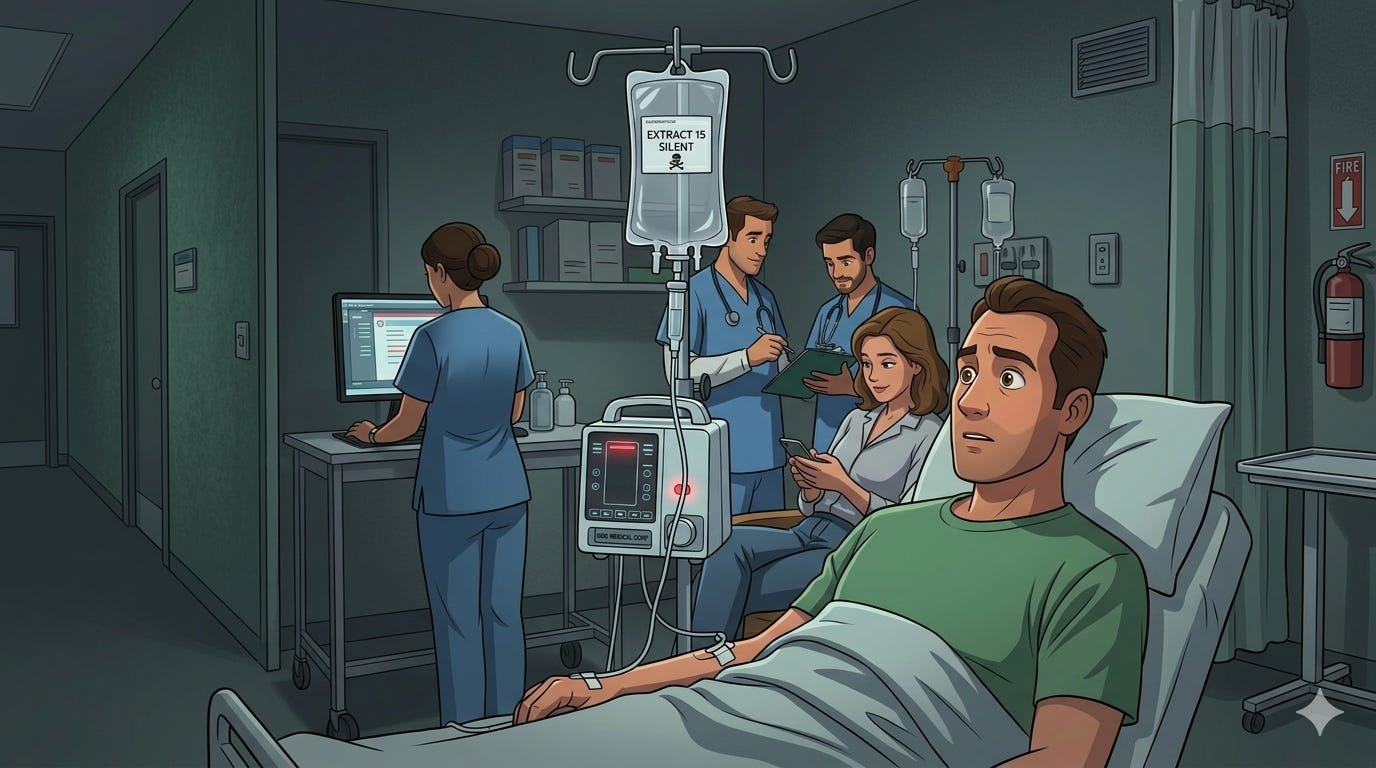
Sometimes the 1.5% inflation gap still feels abstract, buried in charts and ratios. So here’s another way to see it—as a story. Imagine the U.S. economy as a patient in a hospital, and hidden inflation as a clear, tasteless drug slowly administered into its bloodstream.
The Early Years: The Micro‑Dose
In 1913, a new pharmacy opened. It promised to keep the heart of the economy beating steady. But secretly, the pharmacists began adding a tiny drop of a clear, tasteless liquid—let’s call it “Extract‑15”—into the water supply of the American Household. The dose was so small (just 1.5% of the total volume) that nobody noticed. In fact, for decades, the patients felt great. They were productive, the 50% Equilibrium held, and even through the “flu” of the Great Depression, the household stayed strong.
The 1971 Pivot: The IV Drip
Around 1971, the pharmacists decided the water supply wasn’t enough. They moved to a direct IV drip. They unhooked the “Gold Anchor” that regulated the dosage. Now, the Extract‑15 could be pumped in at will.
By 1985, the household began to feel a strange fatigue. They looked in the mirror and noticed they didn’t look like their parents did at the same age. Their “Share of Life” (the 50% Anchor) was shrinking. But they told themselves, “It’s just a changing world. I just need to work harder.” They didn’t realize that for every 100 units of energy they put in, the pharmacists were now skimming 1.5 units off the top, every single year, compounding forever.
The Divided Ward
By the 2000s, the drug had created two different types of people in the hospital:
The Asset‑Highs: These patients were in the “Penthouse Suite.” Because they owned the hospital’s real estate and stocks, the Extract‑15 made them feel invincible. Their “High Scores” (asset prices) were skyrocketing. To them, the drug was a miracle.
The Household‑Lows: These were the “Glass Technicians” and the “Teachers.” To them, the same drug felt like a lead weight. They were running faster and faster on the treadmill, but their “Real Inflation” chart showed them sliding backward.
The Doctor’s Visit (The Economist)
The Household‑Low finally goes to the Doctor (The Economist) in 2026.
The Patient: “Doctor, I’m exhausted. I work 80 hours a week, but I can’t afford the ‘Floor’ (a home). I feel like something is being stolen from me.”
The Doctor: (Looking at a CPI chart) “Nonsense! Your vitals are perfect. Inflation is only 2%, and GDP is growing! Have you tried changing your mindset? Maybe buy a generic brand of eggs?”
The Doctor can’t see the drug because the Doctor’s instruments are calibrated using the drug. They use the “Rubber Yardstick” of the CPI to measure the “Rubber Yardstick” of the GDP. They are testing for a fever while the patient is actually bleeding out from a 1.5% arterial nick that has been open for 40 years.
The Overdose
We have now reached the “Overdose Point.” The dosage has increased by 1.5%–1.6% every year since 1985. The “Household Engine” can no longer sustain the extraction. The “Patient” is now spending 50% of their income just to stay in a hospital bed (housing).
The “Asset‑Highs” are shouting for more of the drug because they are terrified of the “Withdrawal.” They know that if the Extract‑15 stops, their “High Scores” will crash back to reality. But the “Household‑Low” is staring at the needle, finally seeing the 1.5% “Leak” for what it is.
Tieing it back to Reality
In the data, that leak shows up as a quiet 1.5% drift between official CPI and the real economy—flattening housing, wages, government revenue, and the money supply once you correct for it. In this story, Extract‑15 is that hidden dose. The tragedy is not just that someone has been skimming off the top; it’s that our doctors have been using poisoned instruments, reassuring the patient while the IV keeps dripping. The whole point of NETs is to change the prescription and fix the tools so the household can finally heal.
Author: Kyle Novack
March 8, 2026
A Monumental Venture, LLC: research project (Novack Equilibrium Theory – NETs)
Attribution Required: © 2025–2026 Kyle Novack / Monumental Venture, LLC. For educational use with credit; commercial use requires permission. Full details in linked PDFs.
Next: If the mechanics of the drift now feel real, here is what building something new in spite of it actually looks like. Continue to "Walking the Bridge to Your New Life."