


Every Labor Day in Michigan, thousands of people get the chance to do something unusual: they close the Mackinac Bridge to cars and let you walk it.
Five miles over open water. Steel, wind, and a lake on both sides. It’s a tradition, but it’s also something else: a surprisingly accurate picture of what it feels like to build your dream life.
Not the fantasy version where everything “clicks” overnight. The real version of progress is slow, awkward, and invisible for a long time.
The strange thing about the bridge
Since it is a suspension bridge, the bridge itself is not flat. Instead, it is one long arc. At first, it doesn’t feel like much is happening.
You start out with energy. There’s excitement. You’re surrounded by people. You take your first few hundred steps and look up…
And it feels like you’re in the exact same place.
The view hasn’t changed much. The shore behind you looks only slightly farther away. The shore ahead of you doesn’t look any closer. The bridge surface rises so gradually that you’re climbing without really noticing that you’re climbing.
You are putting in effort. Your legs are working. But your brain can’t connect that effort to visible progress yet. There is no satisfying “I’m getting closer” sensation. Just more walking, more bridge, more of the same.
That’s where most people quietly start to think, “Wow, this is longer than I expected.”
The invisible half of the journey
This first stretch of the Mackinac Bridge is the part no one romanticizes.
You’re technically moving forward, but it doesn’t feel like it. The incline is there, but you only notice it as a kind of low-grade resistance—enough to tire you out, not enough to feel dramatic. You can’t see the full distance you’ve already covered, and you can’t clearly see the finish line either.
This is exactly what it feels like when you decide to change your life.
You make a choice:
I’m going to build a business.
I’m going to change careers.
I’m going to get out of this schedule I don’t control.
I’m going to design my days around what matters to me.
At the moment of decision, it feels big, clear, and powerful.
But then the work begins.
You start waking up earlier. You carve out time to write. You study. You build systems. You say “no” to things that used to be automatic “yeses.” You make calls, send messages, build relationships, and learn difficult skills.
And for a while, nothing looks different.
The income looks the same.
The calendar looks the same.
The stress might even look worse.
You’re walking the bridge, but your brain hasn’t yet gotten the payoff of seeing the other side get closer. The effort is real, but the progress is still mostly hard to measure.
This is the most dangerous phase, because it’s where it’s easiest to tell yourself a story that isn’t true:
“If I were on the right path, it would be working by now.”
“Other people seem to move faster than this.”
“Maybe I should go back to what I was doing before.”
You’re not failing. You’re just on the incline.
The moment everything changes
Eventually, if you keep walking, you reach the midpoint of the Mackinac Bridge.
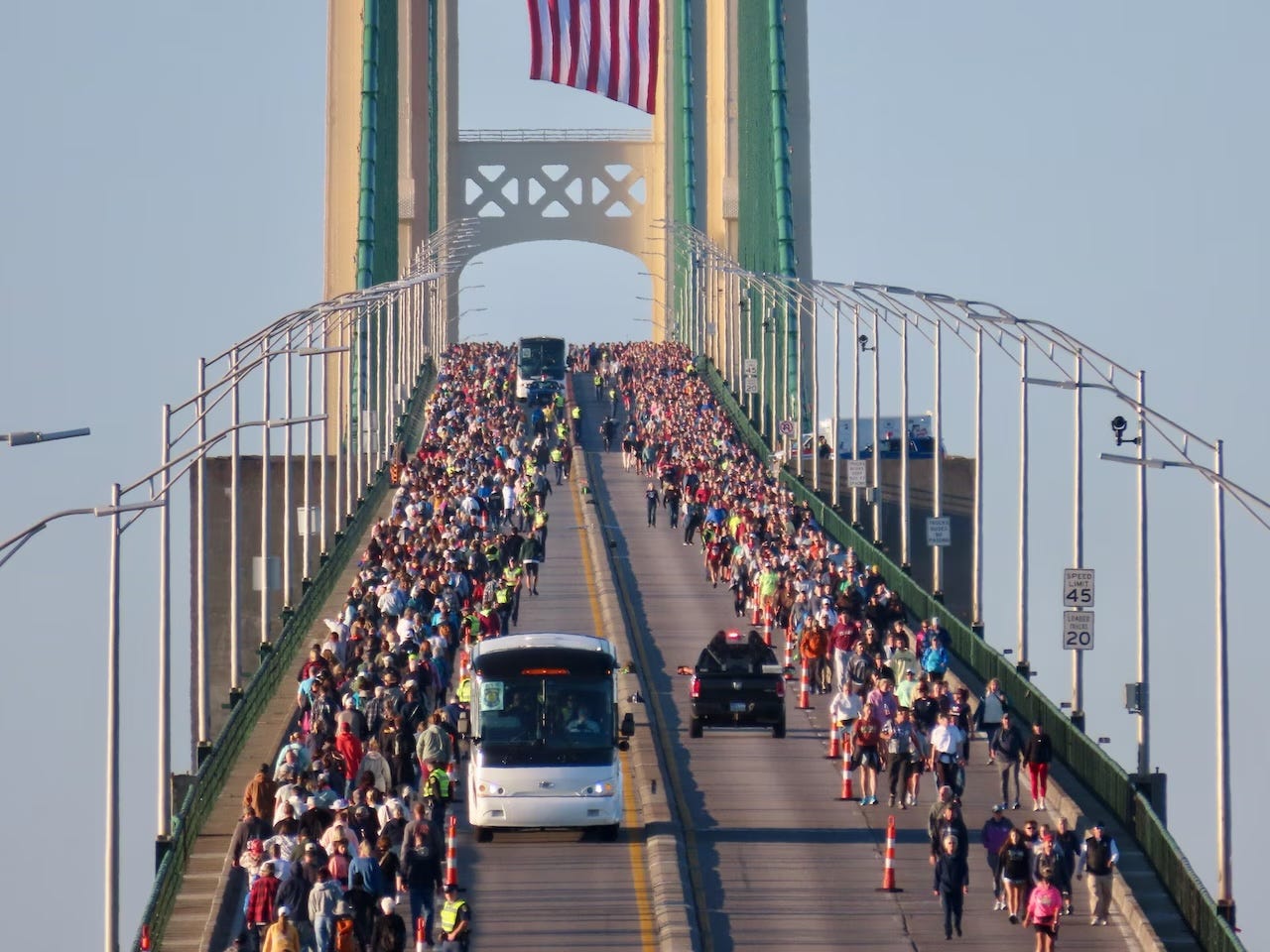
At this point, because of the wall of individuals walking the bridge with you, you’re about an hour into the walk. Then you notice something at the end of the bridge. For the first time, you see the giant banner across the bridge that says FINISH. For the next two-plus miles, you can see the finish line the entire time.
Every step now gives you a visible reward. The shore is getting closer. The details get sharper. Buildings separate from the skyline. What used to be “somewhere out there” becomes “right there.”
You’re still walking, but the psychology has flipped. You no longer have to rely purely on faith that your steps matter. You can see that your steps matter.
Life works the same way.
There’s a point in the process where the grind starts to generate visible results. It could be:
The first time someone you don’t know reaches out because your work resonated.
The first month your “side” income meaningfully covers a real expense.
The moment your calendar reflects your priorities more than your obligations.
The first time you realize, “If I keep doing what I’m doing, this will work. It’s just math and time.”
That’s the top of the bridge. You haven’t arrived yet, but you can see that arrival is inevitable if you keep going.
The work after that isn’t easy, but it’s different. It’s fueled by evidence rather than just hope.
The life I’m walking toward
For me, the “other side of the bridge” is pretty specific.
I’m building a life where I can focus deeply on developing this framework that rethinks how we measure inflation and value, without having to ask permission to use my own time or squeeze it into the margins of everything else.
I’m also building a life where I can choose to be with my daughter and my wife when I want to, not just when a schedule allows me to.
That’s the picture I hold in my mind when the walk feels long.
That’s my shoreline.
And right now, I’m still on the incline.
I’m doing the work that doesn’t always look impressive from the outside: writing, refining ideas, slowly building an audience, and putting structures in place that future-me will rely on. There are days when it feels like just more bridge, more steps, more of the same.
But that doesn’t mean nothing is happening.
It means I haven’t reached the hump yet.
Where are you on your bridge?
If your life feels like effort without obvious progress, it’s easy to interpret that as a sign you’re doing the wrong thing.
Sometimes that’s true. Course corrections are real. But very often, you’re just in the same place as everyone who has ever walked from where they are to where they want to be:
On the invisible half of the bridge.
You can’t feel the finish line getting closer yet. Your legs are tired. The shore behind you doesn’t look that far away. Turning back would be easy.
But the only way to get to that moment, where you can finally see your new life getting closer with every step, is to keep walking when everything in you says, “This isn’t working.”
If you’re there right now, on that long, unromantic stretch, don’t underestimate what you’re doing.
You’re not stuck.
You’re not failing.
You’re not behind.
You’re just not at the top of the bridge yet.
Keep going. The view from the midpoint will change everything.
Next: Before the playbooks and the tactics, there is a question most people skip entirely. Continue to "Grit on the Wrong Bridge Is Just Expensive Mileage."
By Kyle Novack
April 23, 2026
A Monumental Venture, LLC: research project (Novack Equilibrium Theory – NETs)
Attribution Required: © 2025–2026 Kyle Novack / Monumental Venture, LLC. For educational use with credit; commercial use requires permission. Full details in linked PDFs.
Ok I’m back. So what does it feel like from the inside???
Despite different bridges, they both felt like this restlessness I couldn’t shake with an exhaustion that is indescribable. I’m not quite sure exactly how it would be explained other than this pull away. A voice that’s constantly in the background saying, this isn’t it. This isn’t it. And it begins as a whisper but ignored long enough it gets louder and louder until I can’t be ignored.
This is such an awesome analogy, Kyle! First the bridge you’re walking on is a worthwhile one and you’re right that it takes time (more than people often realize) to see the other side of that bridge.
And here’s my advice…as someone who has gotten to the middle of one and jumped off.
Be prepared to be tired when you see the end. Be prepared to be thrilled when you see the end. And most importantly, be prepared for that thill and tiredness to battle.
Come find me if you get tired. I’ll do my best to help remind you of the thrill. 💜