

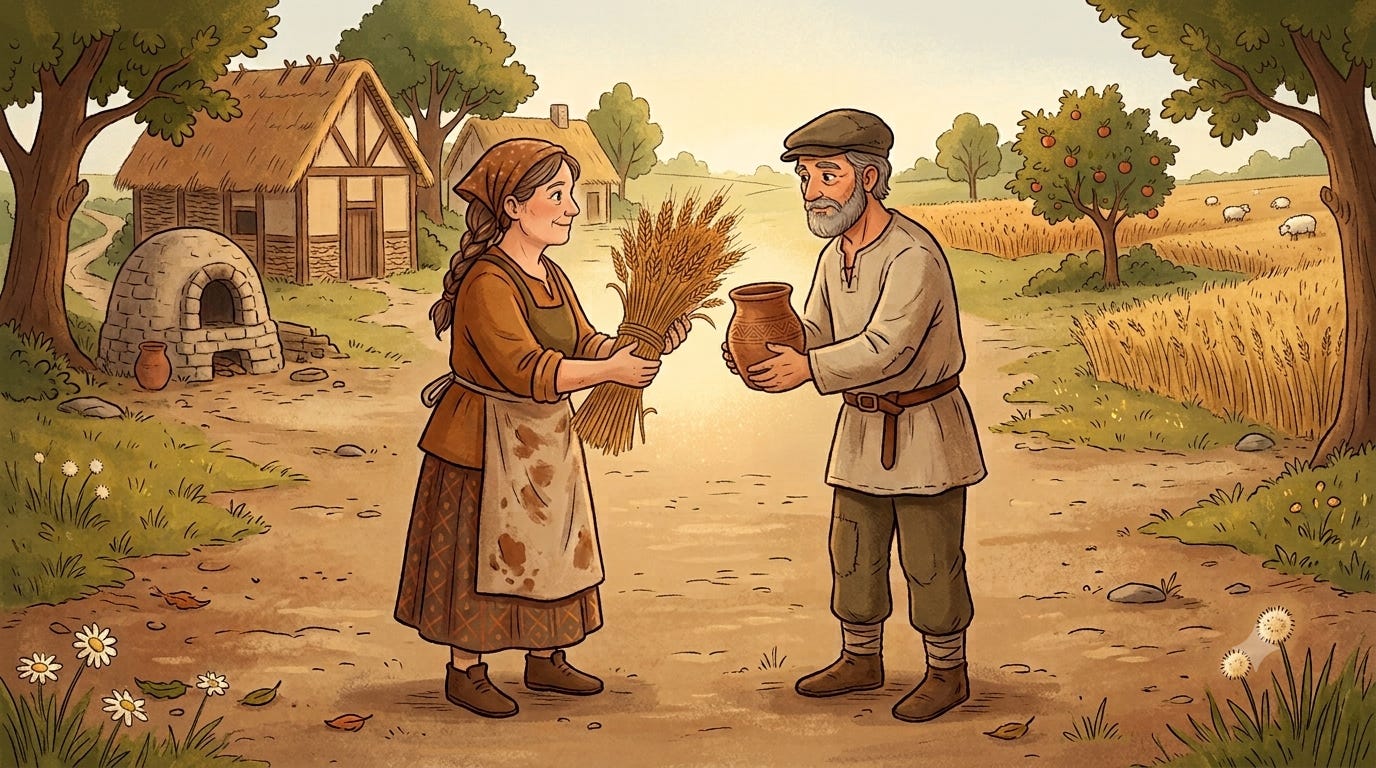
Imagine a village. No banks, no coins, no paper money. Maybe two hundred people, clustered together for safety, growing what they could, making what they needed, surviving the gap between harvests with whatever they had managed to put aside.
Thomas is a potter. He has been a potter since he was old enough to sit beside his father and learn the feel of wet clay between his fingers. He knows how much water turns the clay workable without making it too soft to hold its shape. He knows how long the kiln needs to run. He knows, by the weight of a finished pot in his hands, whether it will crack under heat or last a generation.
Years spent perfecting that craft left him terrible at growing things. He does not have land, and he does not have the knowledge that comes from spending a lifetime watching weather and soil. He has pots. His neighbors need pots. That is the entire foundation of his economic life.
Eleanor farms the land her family has worked for three generations. She knows when to plant and when to wait. She knows which fields drain well after heavy rain and which ones will drown the seed. She has grain. More grain, in a good year, than her family can eat before it spoils. What she does not have is anything to store it in.
Pots for Grain
Eleanor mentions to a friend that she needs something to store her grain in. The friend knows a man named Thomas, a potter, who has been looking to trade for food. Eleanor finds him, and they talk. It does not require a contract, a market, or a currency. It requires only that each has something the other needs and that they are both reasonable enough to agree on what a fair exchange looks like.
Three days of Thomas’s work produces enough storage pots that can hold a family’s grain supply through winter. Two weeks of Eleanor’s harvest produces more grain than she needs. They agree. The pots move in one direction. The grain moves the other.
Neither of them thinks about it in terms of time. Thomas does not say: I spent three days on these pots, therefore I require three days’ worth of your labor in return. Eleanor does not calculate how many hours went into the harvest before she names her price. That is not how it feels from the inside. From the inside, it feels like two neighbors figuring out what is fair.
But fairness must come from somewhere. It cannot be arbitrary. Thomas knows, even if he never says it plainly, that pots he spent three days on are worth more than ones he created in an afternoon. Eleanor knows that a bushel of grain from a difficult harvest, one where the weather turned against her and she had to fight for every yield, feels different from a bushel off an easy year. The effort is in the price, invisibly, even when nobody is counting the hours.
This is the part that gets lost when we talk about early economies. We tend to imagine ancient trade as simple because the goods were simple. A pot is easier to understand than a derivatives contract. But simple goods do not make the underlying logic simple. They just make it easier to see.
What Thomas and Eleanor are doing is exchanging human time. Three days of a skilled potter’s knowledge and labor for two weeks of a farmer’s. The grain is the vessel. The pot is the vessel. The time is the thing being traded.
They would not have said it that way. The concept would have meant nothing to them as an abstraction. But strip away the clay and the grain, and what remains is two people agreeing that their efforts are worth approximately the same, and sealing that agreement by handing each other the product of those efforts.
The economy is not a primitive version of our economy. It is the same economy, in miniature, before the layers of abstraction accumulated. The logic at its center has not changed over time. Only the distance between that logic and what we can see has grown.
Thomas and Eleanor could see it clearly. The pots sat there. The grain sat there. The effort that went into each was still warm.
Same Economy, More Layers
We are still doing exactly what they did. We have just built so many layers between ourselves and the exchange that the original thing has become nearly invisible.
That invisibility is not a problem yet. Not in this village. Not at this scale. The system works because the goods are simple enough that everyone can roughly estimate the effort behind them, and the community is small enough that reputation fills in any gaps the estimation leaves.
The problem comes later. It always comes later.
When the village grows. When the trades get more complex. When the person you are trading with is a stranger whose effort you cannot see and whose reputation you do not know.
That is where this series is going. But before we get there, it is worth sitting with what Thomas and Eleanor had, because it is the thing every monetary system since has been trying to preserve.
A direct connection between effort and exchange. Between the hours a human being commits to something and the value that commitment generates in the world.
They had it without knowing it. We have been trying to get it back ever since.
Author: Kyle Novack
July 3, 2026
A Monumental Venture, LLC: research project (Novack Equilibrium Theory – NETs)
Attribution Required: © 2025–2026 Kyle Novack / Monumental Venture, LLC. For educational use with credit; commercial use requires permission. Full details in linked PDFs.