

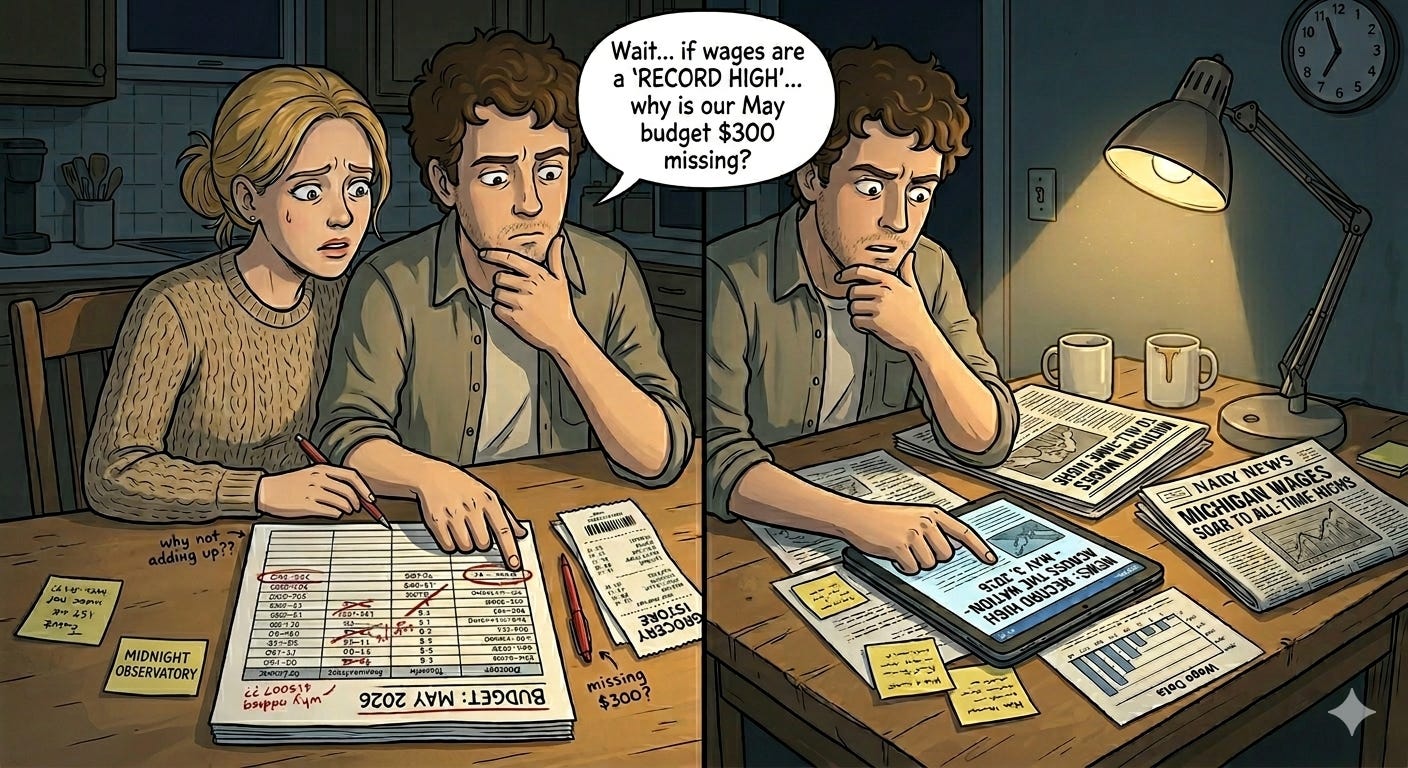
You’ve felt it, that nagging disconnect where the news says the economy is booming, but your wallet tells a different story. Bills pile up, wages stagnate, and basics like housing or healthcare feel out of reach. Meanwhile, GDP ticks up, inflation reports “moderate,” and stocks hit highs. What’s going on? NETs calls this the “two economies” divergence: the measured economy (flawed official stats) versus the felt economy (your lived reality). And guess what? Your gut is right, it’s the true signal of our current state. Let’s unpack why they’re splitting apart and how NETs bridges the gap.
The Measured Economy: A House of Cards Built on Illusions
The measured economy is what policymakers and headlines tout: numbers from CPI, GDP per capita, and productivity reports. On paper, things look stable or even great. Inflation at 3-4%? Growth steady? But NETs reveal the cracks; these metrics systematically understate reality, creating a false equilibrium.
CPI’s Silent Sabotage: As detailed in my chapters on CPI flaws and inflation mismeasurement, official figures understate true price erosion by about 1.5% annually for over 125 years. Why? They ignore population-adjusted money supply growth, tech-driven deflation masks, and non-farm costs absorbing savings (e.g., Food Puzzle dynamics where ag productivity soars but prices don’t drop). Result: The measured economy says “affordable,” but your grocery bill diverges higher.
Productivity’s Hidden Deflation: Last century’s boom (Chapter 7) doubled output in food, tech, and more, so everything should be cheaper. But measured stats flip it: “growth” hides deflationary power, inflating asset bubbles while real wages lag. The divergence? Official numbers celebrate efficiency; your felt experience sees costs rising anyway.
Darwinian Drift: Economies, like ecosystems (as I will explore in another post), seek natural balance. But manipulation (e.g., endless stimulus to avoid recessions) pushes us further from utopia. The measured economy pretends harmony; the felt one feels the chaos, diverging paths leading to instability.
In short, the measured economy is a polished narrative, but it’s diverging from ground truth because it ignores time as the core currency (Time-Debt). Over decades, this split compounds: What felt affordable in 1990 now crushes budgets, even as stats claim progress.
The Felt Economy: Trust Your Gut, It’s the Real Reality
Here’s the empowering part: That deep “something’s off” feeling isn’t paranoia, it’s your intuition detecting the divergence NETs quantifies. The felt economy is the raw, unfiltered truth: How far your time (effort, hours worked) stretches for basics. It’s why millennials/Gen Z struggle more than boomers (a generational gap post coming soon), why health/housing bubbles feel unsustainable, and why the stock market’s “highs” scream a warning.
Daily Divergence Example: Felt: Gas, groceries, rent up 20-50% post-COVID, yet wages barely budge. Measured: “Inflation cooling to 3%.” NETs explain that true erosion (money-supply flooding) outpaces reported figures, invisibly eroding purchasing power.
Gut as Guide: In a Darwinian system, survival means adapting to reality, not illusions. Your inner sense spots inefficiencies (e.g., corporate capture inflating food prices despite yields) before stats do. NETs validates this: Listen to it over headlines—it’s the signal for equilibrium resets, such as necessary recessions (Chapter 3).
Right now in 2026, the split is widening: AI/productivity surges promise deflation, but measured policies (e.g., Fed tweaks) keep inflating assets while felt costs diverge. Your gut knows, bubbles don’t pop on paper alone.
Bridging the Gap with NETs: Toward a True Equilibrium
NETs isn’t just a diagnosis, it’s a fix. By pegging currency to time (Time-Token), we realign measured and felt realities: Transparent metrics, wages reflecting true value, economies self-correcting like ecosystems. No more divergence; just honest balance.
If this resonates with you, you are not alone. Join the conversation and get the data to back your feelings. What’s your biggest felt vs. measured mismatch? Comment below, and subscribe for more (next: The Darwinian economy and why manipulation backfires).
Self-Audit: Lived experience as the proof
Do your wages feel like they’ve kept pace with your grocery bill?
Do you feel like you are working harder than your parents did for the same “floor” of living?
Does the “inflation” you see at the checkout line match the 3% the news reports?
Next: If the dollar itself is the part that is unreliable, there is a deeper question worth sitting with first. Continue to "Human Time Is the Real Currency of the Economy," a question this series will come back to and answer with data later.
Author: Kyle Novack
March 8, 2026
A Monumental Venture, LLC: research project (Novack Equilibrium Theory – NETs)
Attribution Required: © 2025–2026 Kyle Novack / Monumental Venture, LLC. For educational use with credit; commercial use requires permission. Full details in linked PDFs.