

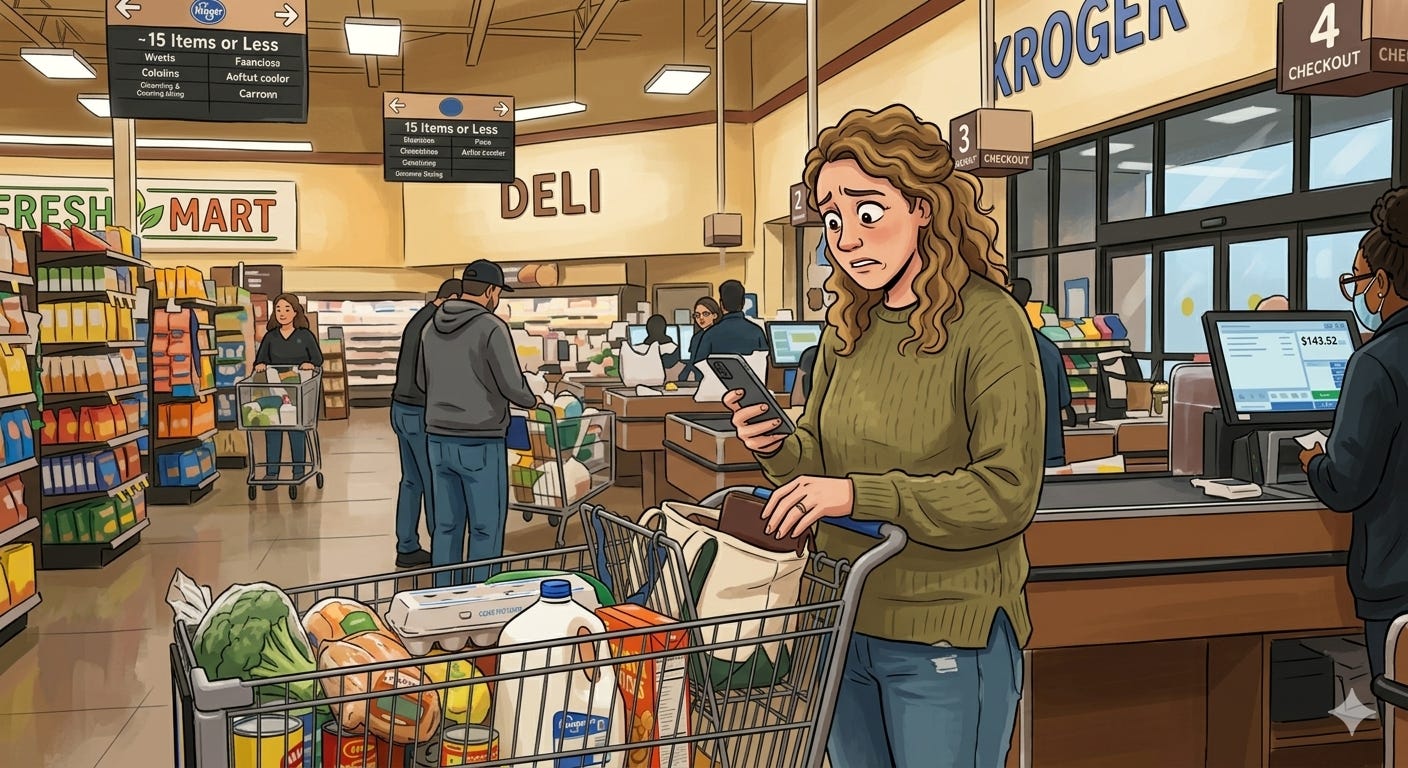
When an iPhone gets more expensive, most of us shrug.
When rent, groceries, gas, and utilities go up, we panic.
That difference is the doorway into a better explanation of value.
In a recent Substack post, I wrote about the current war involving Iran and why, despite the headlines, it’s unlikely to cause sustained inflation. We care about the war, but most of us are more concerned with how its consequences will affect our lives. We ultimately care about the oil.
We don’t fear “oil” in the abstract. We fear being forced to spend more of our paycheck on the same recurring essentials we can’t stop buying: fuel, groceries, rent, electricity, water. When those bills rise, it feels like our life is getting more expensive even if the latest gadget isn’t.
That feeling is not a psychological glitch. It’s a clue that standard explanations of value are missing something important.
What textbooks get right (and where they stop)
Standard microeconomics says: the first slice of pizza is amazing, the fifth is fine, the tenth makes you sick. Each extra slice gives you less additional satisfaction than the previous one. That’s diminishing marginal utility. You’re willing to pay a lot for early units, less for later ones.
The classic fix to the Diamond–Water paradox builds on this. Water is essential but abundant, so each additional unit of water yields diminishing marginal utility. Diamonds are useless but scarce, so the marginal stone is very valuable. Put another way, water can’t really be used as a wealth indicator, but a diamond can.
It sounds like a reasonable solution, but when you stop to think about it, the marginal‑utility explanation sidesteps Adam Smith’s real puzzle:
· Why does something essential to life carry a low price, while something almost useless carries a high price?
· Why, in normal times, do we accept cheap water and expensive diamonds, but in a crisis we instantly flip and trade diamonds for water?
The marginal‑utility story says, “price is tied to marginal units, not total importance.” True, but incomplete. It describes how you feel about slice one vs. slice five of pizza. It doesn’t explain why any slice of life‑sustaining food is treated as cheaper than a useless diamond in the first place.
To answer that, we need one more layer.
Good economics needs three main ingredients: micro, macro, and human psychology. Micro tells us how individuals and firms trade off needs and wants; macro tracks money, credit, and the big aggregates we care about; psychology explains how real people actually behave under calm and crisis. Leave out any one of them and the theory might look elegant on paper, but like a cake without flour, sugar, or eggs, it will never really set in the real world.
Two layers of value: functional vs. priced utility
We need to distinguish between:
Functional utility
How much your survival and day‑to‑day functioning depend on the good.
On this dimension, food and water obviously dominate diamonds.
Priced utility per unit
How the market ends up pricing a single unit (a slice of pizza, a gallon of water, a carat of diamond) at a given moment.
Textbooks mostly live on layer two and say: “Given abundance and scarcity, the marginal unit of water is cheap, the marginal unit of diamond is expensive.” That’s not wrong. But it doesn’t ask how these prices interact with life’s recurring reality.
Food and water are not one‑time purchases. They are constant survival subscriptions.
The recurring burden of essentials
A typical family of four might easily spend 13,000–19,000 dollars a year on food at home and away from home, in dozens of small trips—20 dollars here, 100 dollars there—just to keep everyone fed (U.S. Department of Agriculture, 2025). Historically, American households often spent a quarter or more of their budgets on food; in some periods and income groups, it was closer to 40–50 percent (Bureau of Labor Statistics, 2006). However, after COVID, the BLS Consumer Expenditure Survey began experiencing response‑rate issues, making the more recent data unreliable. For a more accurate picture today, using the USDA food plans for a family of four and comparing them with current median household income, that food share still lands somewhere around 15–22 percent for many families—hardly a trivial line item (U.S. Census Bureau, 2025).
If that share had remained near those higher levels, almost all household budgets would have been trapped in survival mode. Very little would be left to support demand for anything else:
· Better housing
· Education
· Entertainment
· New technologies or services
As the food share falls, something critical happens: you free up a large slice of the paycheck to be spent on other goods and services. That liberated spending is what allows the rest of the economy to exist and grow. Cheap essentials are not a quirk of the system; they are a prerequisite for a complex, innovative economy.
So:
· Functional utility: Food and water are vastly more important than diamonds.
· Priced utility per unit: Because food and water must be purchased constantly, the system must keep their unit price low enough that the lifetime bill is survivable. Diamonds can be priced absurdly high because they are rare, optional, and non‑recurring.
· Saving: Essential spending never stops, while diamond (non‑essential) spending can be spread over time or skipped entirely to reduce the cost burden.
Food doesn’t cost less than diamonds because it matters less. It costs less per unit because it matters too much and shows up too often. Markets and politics conspire to keep the price of essentials down so households can survive their enormous lifetime cost and still have enough left over to drive demand for the rest of the economy.
Why do people trade diamonds for water in a crisis
Now look at a crisis: drought, siege, contamination, war.
We regularly see people behave in ways that make the simple “abundance vs. scarcity” story feel thin:
People will trade jewelry, gold, or anything portable for water and food.
The willingness to pay for the next gallon of drinkable water explodes, even before the last gallon disappears.
Fear of not finding more tomorrow becomes just as important as actual scarcity today.
Water’s functional importance hasn’t changed. What has changed is that the normal system—productivity, infrastructure, logistics—that keeps water priced cheaply per unit has broken down or is perceived as fragile. Once that protective shell cracks, the underlying hierarchy asserts itself:
Food and water jump to “priceless.”
Diamonds suddenly look like rocks you’re willing to dump to secure the basics.
Standard marginal utility can always say “the marginal utility curve shifted in a crisis.” But it doesn’t tell you why essentials should be able to flip the entire price hierarchy during bad times and then return to being “cheap” during good times.
The two‑layer view does:
In normal times, productivity and stable access let us suppress the priced utility per unit of essentials, even though their functional utility is highest.
In a crisis, that suppression fails, and prices snap toward functional reality. People trade diamonds for water because they have always lived in a world where water’s true importance has dwarfed that of diamonds; a crisis just removes the illusion.
Where the 1.5% inflation drift hides
Once you see essentials as constant survival subscriptions whose per‑unit prices are deliberately kept low, a different question pops up: what if our main yardstick for “how expensive life has become” is quietly undercounting that process?
In Novack Equilibrium Theory, I argue that official CPI has understated real inflation by roughly 1.5 percentage points per year for over a century. That small‑sounding gap compounds into something huge:
The dollar has lost closer to 99.36 percent of its value since 1913, not “just” ~96.8 percent.
A century‑long deflationary boom in productivity has been misread because CPI was calculating inflation on numbers that have already been adjusted by the market, reducing measured inflation
Essentials look more expensive than they were in the past, but they really aren’t in time-adjusted terms.
Now combine that with the dynamics above.
If technology and productivity are continually driving down the real cost of essentials (food, basic energy, etc.), then any persistent mismeasurement of inflation will show up most painfully in exactly those categories. It’s also where the strain runs in both directions: the food industry needs higher prices to keep quality and stay solvent, while households—whose real incomes have quietly eroded—feel like even basic items are slipping out of reach. We see the sticker price of a pound of ground beef jump from about $ 2 25 years ago to around $6 today and think “nothing changed and the product is worse” (Bureau of Labor Statistics, 2025). In reality, a broken inflation yardstick and falling real wages are colliding right at the grocery checkout.
Why?
Essentials are recurring; you can’t avoid them.
Their true productivity‑driven price path is downward.
Any measurement error that hides deflation becomes a “food puzzle,” and an affordability crisis in the very goods people buy every week.
So if you want to find the distortion from a 1.5 percent CPI drift, don’t start with luxury goods or speculative assets. Start with groceries, gas, and rent. That’s where you are forced to live with the broken measuring stick every month.
Oil shocks as a live case study
This is exactly why we emotionally overreact to oil shocks.
When a war threatens oil supply, your brain doesn’t picture a barrel of crude in a textbook diagram. It pictures:
· The cost to fill your tank
· The impact on shipping and trucking
· The ripple into the price of everything transported, especially food
In my earlier Substack on the current war involving Iran, I argued that even a serious conflict is unlikely to generate sustained inflation in the near term, because the monetary conditions are not right to allow inflation. Businesses will be forced to change their purchasing decisions to sustain current prices. This doesn’t mean short‑term price spikes can’t happen, but once you correct the measuring stick, this new spike is only a bump; the long‑run downward pressure on essentials still comes from productivity.
But the public reaction to those spikes—the panic, the political noise—is a real‑time referendum on this functional vs. priced utility story. People know, at a gut level, that when oil rises, it threatens the affordability of the recurring essentials they care about most. They don’t want to spend more of their finite human time and income just to stand still.
Bringing it together
Adam Smith’s Diamond–Water paradox was really about this question:
Why does a good with extremely high real‑world importance (water) carry a lower price than a good with almost no real‑world importance (diamonds)?
The textbook marginal‑utility fix—“price is about the marginal unit, not total importance”—is logically correct but emotionally unsatisfying. It never really connects to how people live, budget, and panic.
A more complete answer is:
Food and water have the highest functional utility and are bought constantly, year after year. To keep households and the wider economy from being suffocated by survival expenses, the system must keep its per‑unit prices low.
Diamonds have trivial functional utility and are rarely bought. Their per-unit price can fluctuate to extreme levels without threatening anyone’s survival or the broader economy.
In normal times, productivity and stable access suppress the priced utility of essentials; in crises, that suppression cracks, and their true priority is revealed when people trade diamonds for water.
If you want to see how this plays out in real time, with a shooting war and an energy shock that still don’t add up to runaway inflation, go read my Iran war piece after this one. It’s the same story from a different angle: oil as the gateway to understanding why we hate paying more for the things we can’t stop buying.
Next: Before the CPI series, here is a standing reference for the core vocabulary used throughout: "Back to Basics: What Economics Really Measures." Keep it bookmarked; you can return to it anytime a term needs a plain definition. Continue to "What Is CPI, and Why Does It Run the Economy?"
Reference
· Bureau of Labor Statistics. (2006). 100 years of U.S. consumer spending: Data for the nation, New York City, and Boston (BLS Report 991). U.S. Department of Labor
· Bureau of Labor Statistics. (2025). Average retail food prices: Ground beef, 100% beef, per pound, U.S. city average [Data set]. U.S. Department of Labor. https://data.bls.gov/pdq/SurveyOutputServlet
· U.S. Department of Agriculture, Food and Nutrition Service, Center for Nutrition Policy and Promotion. (2025). USDA Food Plans: Cost of food at home, monthly reports [Data set]. https://www.fns.usda.gov/research/cnpp/usda-food-plans/cost-food-monthly-reports
· U.S. Census Bureau. (2025). Income in the United States: 2024 (Current Population Reports, P60‑286). U.S. Department of Commerce. https://www.census.gov/library/publications/2025/demo/p60-286.html
· Bureau of Labor Statistics. (2025). Average retail food prices: Ground beef, 100% beef, per pound, U.S. city average [Data set]. U.S. Department of Labor. https://data.bls.gov/pdq/SurveyOutputServlet
Author: Kyle Novack
March 13, 2026
A Monumental Venture, LLC: research project (Novack Equilibrium Theory – NETs)
Attribution Required: © 2025–2026 Kyle Novack / Monumental Venture, LLC. For educational use with credit; commercial use requires permission. Full details in linked PDFs.