

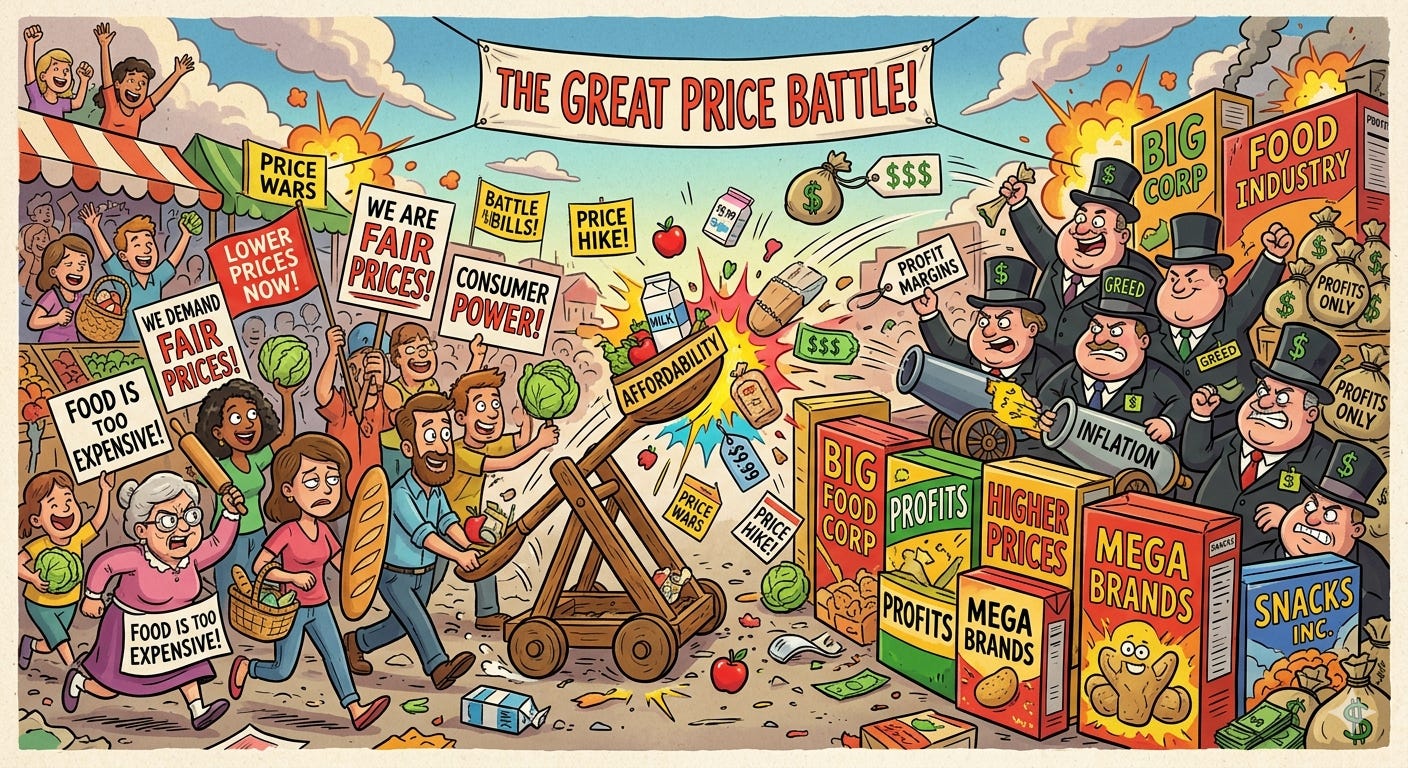
To understand why food corporations struggle to keep prices elevated, we need more than corporate financials. We need to look at how the food market works when ordinary people make choices. The key idea is that food has two different kinds of utility: its functional utility (you need it to live) and its priced utility (what you are willing and able to pay per unit, given your budget and alternatives). The tension between those two layers is what makes food such a difficult sector to sustain high prices.
Functionally, food is at the top of the hierarchy. Without it, nothing else in the economy matters. But because food must be purchased repeatedly, often multiple times per week, the system cannot tolerate very high prices per unit for long without causing severe strain on households. Markets and politics push hard in the opposite direction: they work to suppress the priced utility of food, keeping each unit as cheap as possible so that families can survive the enormous lifetime cost of eating. Well still have money left over for housing, services, and everything else that makes a modern economy possible. Food does not cost less than luxuries because it matters less; it costs less per unit precisely because it matters so much and shows up constantly.
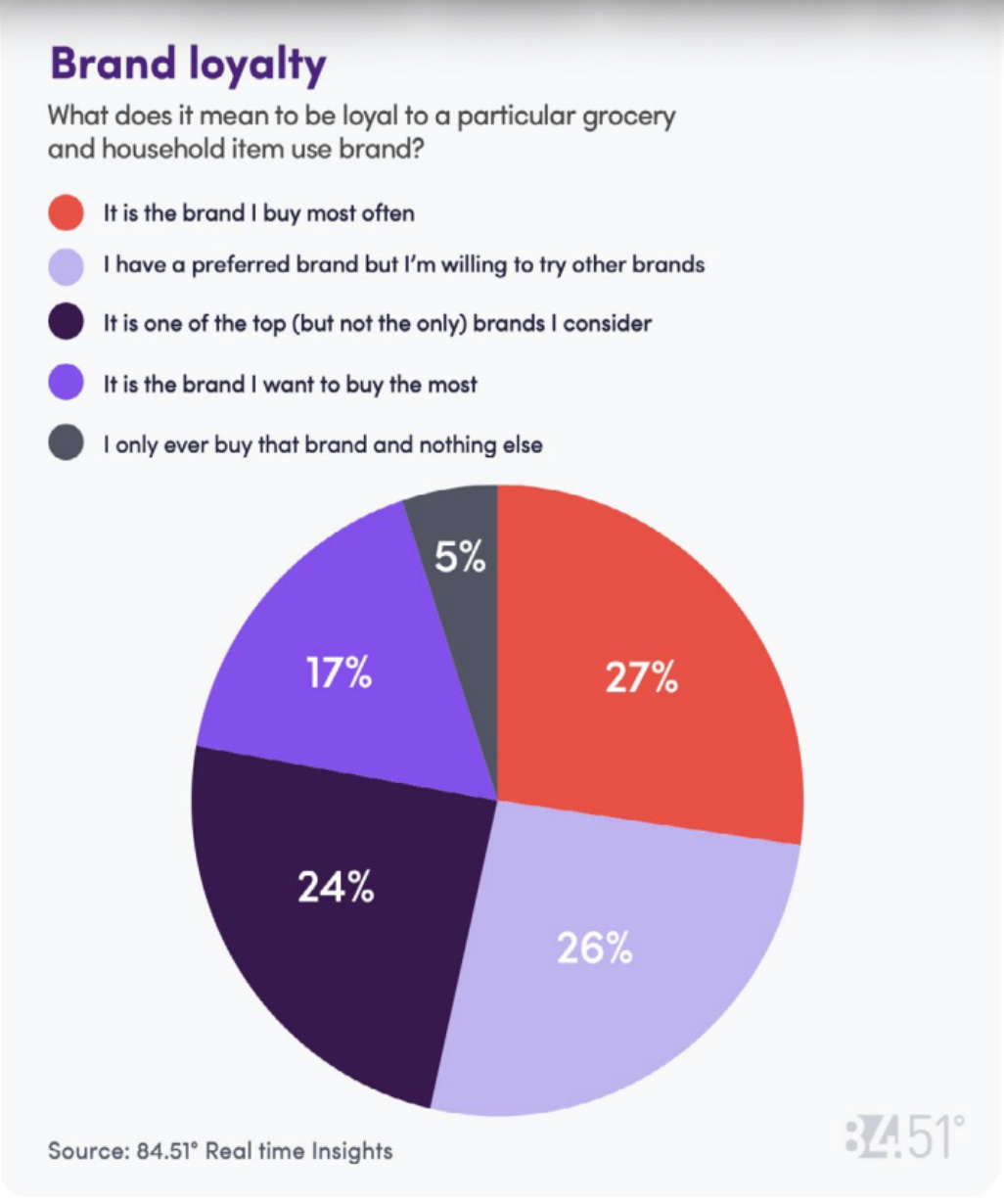
Once we see that distinction, consumer behavior in food markets becomes easier to interpret. When people stand in front of a shelf, they are not choosing between “food” and “no food.” They are choosing among many versions of “functionally acceptable” food, and their attention shifts to price and perceived value. A study by 84.51°, a Kroger‑owned analytics firm, found that about 60% of respondents said their purchase decisions were driven by whether a brand was a good value for the money. Only around 5% said they would buy one brand and nothing else. In food, “brand loyalty” usually means “my first choice if the price is close,” not “a product I will defend at any price” (84.51°, 2023).
That is why private labels and substitutes matter so much for pricing power. As a Sevendots analysis notes, private‑label products have been gaining share in more commoditized food categories where perceived differentiation is low, and brand equity is weak or eroding. Such as canned goods, everyday bakery items, and snacks. If a bag of branded tortilla chips costs one dollar more than the store brand, a growing share of shoppers simply shifts to the cheaper bag. Functionally, both chips serve the same purpose: they satisfy hunger, fill the bowl, and pair well with salsa. Once functional utility is “good enough,” the decision pivots to priced utility—what combination of taste and price feels like the best deal (Bielli & Mcasllister, 2025).
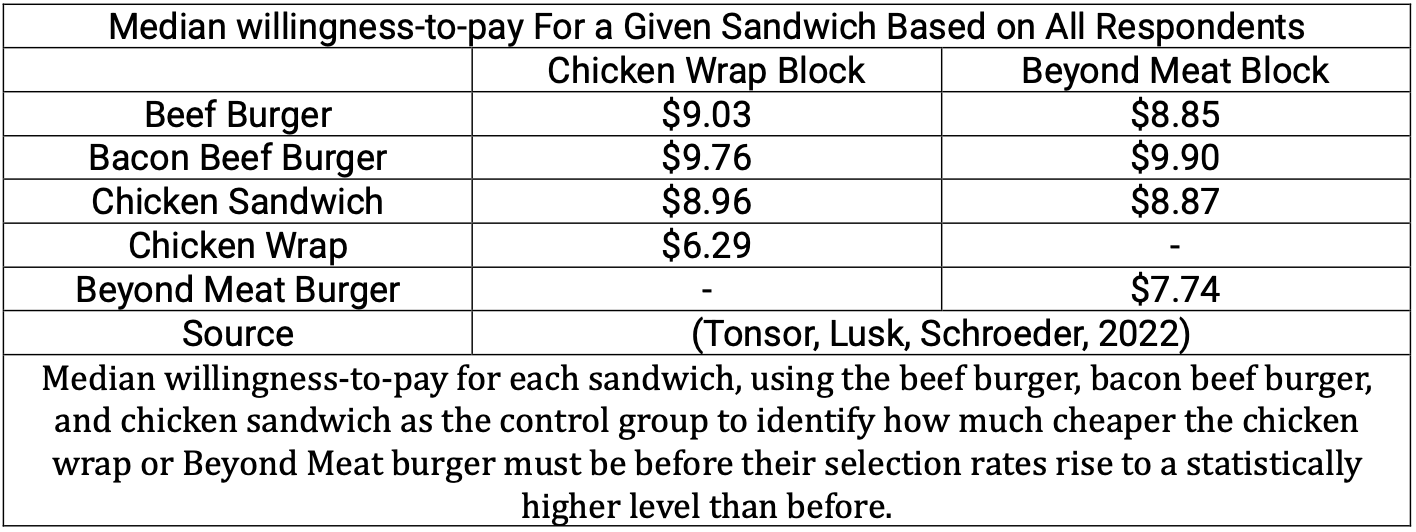
Experimental work on willingness to pay for different food options shows the same two‑layer pattern. In one set of studies on plant‑based protein alternatives, researchers offered respondents several sandwiches (beef burger, bacon beef burger, chicken sandwich, and Beyond Meat burger in one group; beef burger, bacon beef burger, chicken sandwich, and a chicken wrap in another) and varied prices across nine scenarios. People did not abandon their preferred options immediately because those options still carried a higher perceived functional utility (familiar taste, satisfaction, habit). But when the chicken wrap was made nearly $3 cheaper than the others, or the Beyond Meat burger about $ 1.10 cheaper, measurable shifts in choices appeared. Price did not override the function immediately; it did so only after the value gap widened sufficiently (Tonsor, Lusk, Schroeder, 2022).
Another study they conducted focused on ground protein choices: two beef options, two plant-based options, a chicken option, and “other” category, while varying only the price per pound at the grocery store. At the intermediate price level, Tyson’s chicken breast was chosen about 45% of the time because it offered a strong combination of functional utility (perceived health, familiarity) and price utility (acceptable cost). When the price of Beyond Beef alone fell by one dollar, its projected share almost doubled, from 3.63% to 7.04%, mainly at the expense of the Impossible Burger. When store‑brand 80% lean ground beef became cheaper, its share rose while more expensive beef options lost ground. The functional utility of chicken and branded beef did not change; what changed was their price position relative to the alternatives (Tonsor, Lusk, Schroeder, 2022).
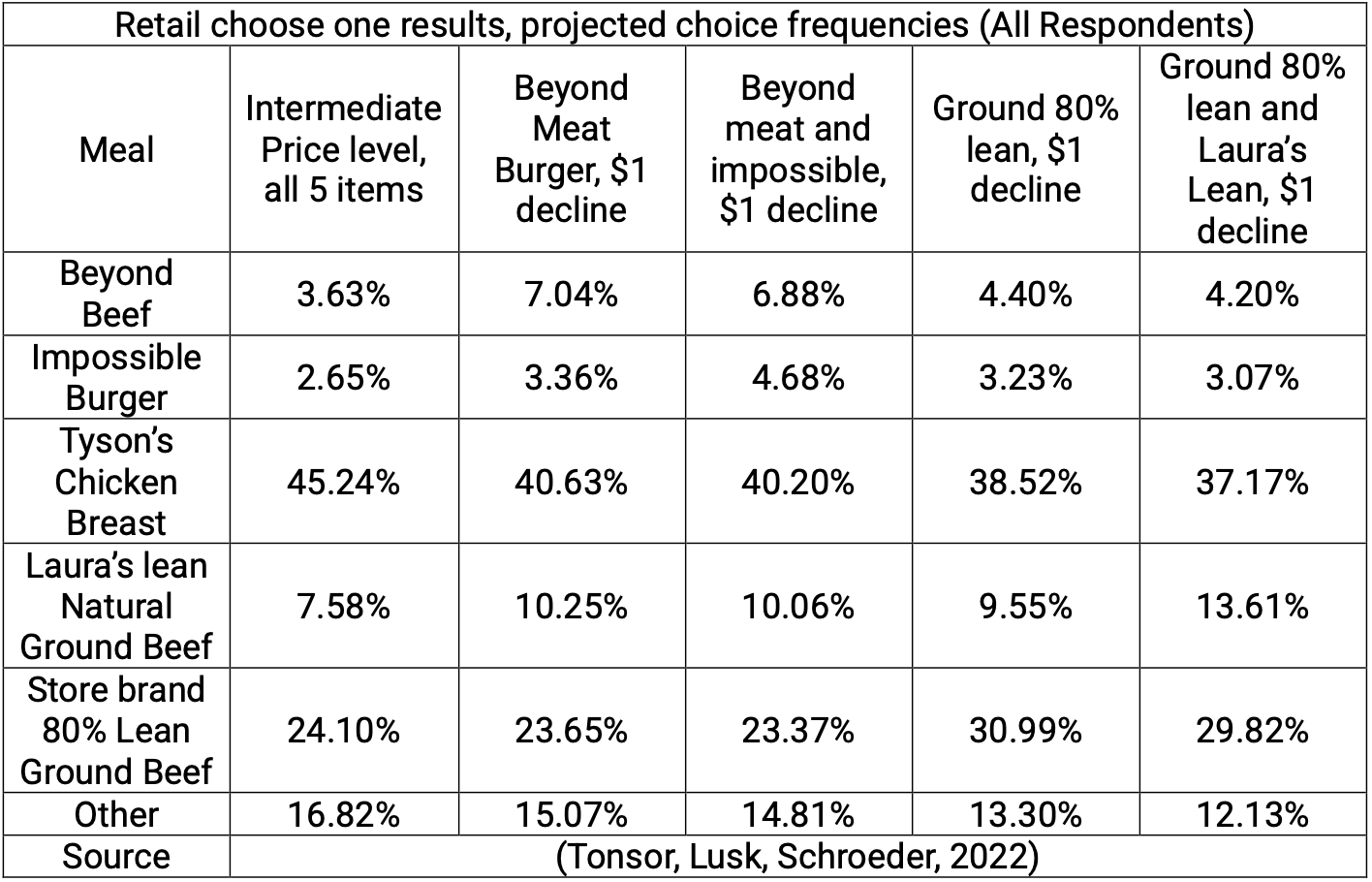
The most striking finding was that lowering the price of a perceived “healthier” plant‑based option not only increased its own share but also nudged more consumers toward Laura’s Lean Natural Ground Beef, even though Laura’s Lean sticker price stayed the same. A shift in one product’s priced utility altered the value landscape for another product whose price did not move. And when both ground beef options dropped by one dollar, the projected selection rate for chicken fell from 45.24% to 37.17%. Almost eight percentage points of demand moved away from chicken purely because beef’s priced utility improved, even though chicken’s functional utility was unchanged (Tonsor, Lusk, Schroeder, 2022).
These results put pressure back on the corporations in an important way. In normal times, the functional utility of food is non‑negotiable. People must eat, and many products easily clear the “good enough” bar on taste and quality. That makes the market unusually sensitive to small changes in priced utility, relative price, and perceived value, because once the function is satisfied, price differences become the main lever. A seemingly modest price increase can cause a brand to lose volume to private labels or rival products that now appear to offer better value. Even holding your own price steady while competitors cut theirs can hurt your sales, because consumers evaluate you in a relative, not absolute, frame.
For food companies, that is a difficult environment in which to keep prices high, just because they would like to. Every unit they sell carries real costs for labor, ingredients, packaging, and logistics, but every attempted price increase collides with consumers who have both the incentive and the ability to trade down to cheaper yet functionally acceptable alternatives. In this sector, high functional utility coexists with frequent repetition and abundant substitutes. The result is strong downward pressure on utility prices over time.
Any story that blames persistently high food prices on corporate power alone must reckon with this two‑layer reality. The functional importance of food does not give corporations unlimited pricing power. It invites the opposite: a system in which competition, politics, and consumer behavior work together to keep unit prices as low as they can be sustained. That is why, when we are looking for the missing savings from a century of productivity gains, we cannot simply point to food companies and assume they have captured them. The structure of food demand itself makes that very hard to do. Market Power and corporate capture you are dismissed from the witness. Next we are calling External Shocks and Offsets to the witness stand to see if natural disaster and supply constraints can consume the cost savings.
Next: With market power ruled out, the next suspect is bad luck itself. Continue to "Scarcity Was Never the Problem."
Sources
Bielle, A., & McAllister, C. (July 24, 2024). The return of Private labels: Why retailer brands are reclaiming growth in the global CPG market. Retrieved January 2, 2026, from https://sevendots.com/the-return-of-private-labels-why-retailer-brands-are-reclaiming-growth-in-the-global-cpg-market/
84.51°. (2023). The loyalty shift decoded: Key insights for winning shopper devotion in an uncertain economy [White paper]. https://www.8451.com/loyalty-shift-decoded/
Tonsor, G. T., Lusk, J. L., & Schroeder, T. C. (2022). Market potential of new plant‐based protein alternatives: Insights from four US consumer experiments. Appl Econ Perspect Policy, 2022: 1-18. https://doi.org/10.1002/aepp.13253
Author: Kyle Novack
April 07, 2026
A Monumental Venture, LLC: research project (Novack Equilibrium Theory – NETs)
Attribution Required: © 2025–2026 Kyle Novack / Monumental Venture, LLC. For educational use with credit; commercial use requires permission. Full details in linked PDFs.