

At some point, most of us have sat down to figure out why the numbers do not add up. We make a list. We go through the subscriptions, the grocery runs, and the small purchases that seemed reasonable at the time. We look for the leak. If we cannot find one, we assume we need to make more money. So we look for ways to do that too.
But then you listen to a financial podcast, or sit down with a budgeting guide, or have a well-meaning conversation with a friend about money, and you realize your income is not the outlier you thought it was. You hear stories of people making less than you who are managing fine. And you keep hearing the same conclusion: if you are coming up short, the answer is in your behavior. Cut the spending. Prioritize. Tighten up. Be more intentional. The advice is delivered with confidence because it is not wrong exactly. It is the logical conclusion because you have direct control over how you manage your household.
So you tighten up. And then you notice something that does not fit the narrative. Everyone around you is saying the same thing. The people who called into the podcast. The friends who seem to have it together. The coworker who makes more than you do. Everyone is feeling it. Every month seems a little harder to balance than the last. At some point it becomes difficult to believe that everyone is just bad at managing money.
But there is a question the financial podcasts never ask. Not because they are hiding anything, but because it genuinely has not been part of the conversation.
What if the problem is not your spending? What if the problem is not your income, your discipline, your priorities, or your choices? What if the ruler you have been using to measure your own financial reality has been slightly wrong for so long that the error has become invisible?
That is not a comfortable question, and it is not a very actionable one either. The easier responses are ones most of us have already tried: work on yourself, or conclude the system is rigged against you. Both have the advantage of pointing to a specific place. One points inward. The other points at a villain. And here is the honest part: neither of those explanations is entirely wrong. Habits do matter at the margins. There are real, documented structural inequities in the system. But what happens if fixing your behavior and identifying the villains still does not close the gap? What happens if both of those things are operating more or less as expected, and the numbers still do not add up? If that is the case, where do you even look next? And more importantly, how would you know?
Some people have asked that question. The suspicion that inflation is being underreported has been growing for years, and that instinct is not wrong. But the answer most people reach for, that someone is deliberately manipulating the numbers, is harder to prove and easier to dismiss. What the data actually suggests is something more specific and more verifiable: the measurement was not manipulated. It was miscalibrated. Not because anyone decided to lie, but because the instrument was designed to measure one thing and has been used to measure something slightly different ever since. Nobody hid the error. Nobody corrected it either.
That distinction matters because a manipulated number requires a conspiracy to explain. A miscalibrated one only requires a design choice that was never revisited. One is a scandal. The other is a foundational problem. And foundational problems, unlike scandals, can actually be fixed.
And the evidence that something structural is happening is no longer limited to lower-income households. The squeeze is now showing up in six-figure incomes, in households that did everything right, in people who have no easy behavioral explanation left to reach for. When the gap follows you up the income ladder, the ladder is not the problem.
What follows is the story of two fictional people living inside the economy we live in every day. Their details are invented. The forces compressing their lives are not. And every year, Tuesday gets a little harder.
A Nurse, a Mother, and a Budget That Does Not Balance
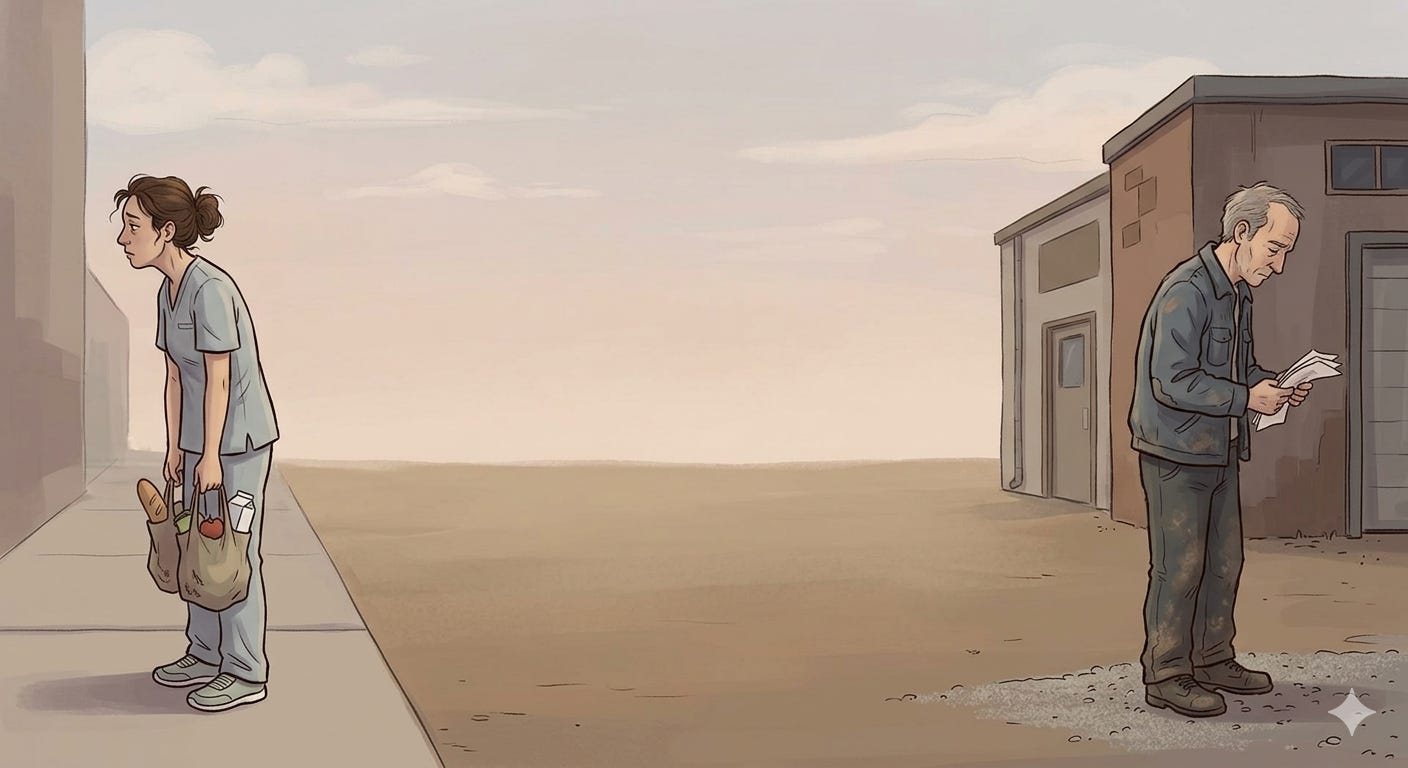
Sarah does not think about monetary policy. She thinks about Tuesday.
Tuesday is when both boys need to be at different places at the same time, when the hospital schedule runs long, and when she realizes, standing in the checkout line, that she miscalculated again. Not by much. Maybe forty dollars. But forty dollars is the difference between the electric bill getting paid on time and it not.
She puts back a few things she can do without this week.
It is not a crisis. She knows that. She has a job, a decent one, and she knows people who have it worse. But three years ago, she did not do this math. Three years ago, she did not have to choose. She is not sure what changed. She has not moved. She has not had another child. She got a raise last year, a real one. And still, every month, the numbers come out a little short in a way she cannot fully account for.
She has theories. The grocery chains are gouging, she heard that somewhere. She also remembers how badly COVID broke the supply chains and how things never seemed to fully recover. Sarah recalls a news piece about rent being up everywhere, not just here. These explanations feel true enough when she hears them, but they do not actually tell her why her specific situation, with her specific income, keeps coming up short in a way it did not used to.
So she lands, quietly and without much conviction, on the explanation that requires the least outside information: her income is okay. Things are relatively okay. She probably just needs to be more disciplined, to track things more carefully, to stop letting small expenses slip through. Next month, she will do better.
She tells herself, “What else could it be? I am making a good income of $94,000; it must be me.”
A Small Business Owner, a Loyal Workforce, and a Cost Structure That No Longer Works
Mike does not doubt himself. He has the invoices.
He has been running the same plant for eleven years. He knows what steel cost in 2012 and he knows what it costs now. He knows what his health insurance premium was when he hired his first employee and what it is today. He is not confused about his numbers. His numbers are the problem.
After reviewing his financial statements, he knew input costs had increased by 31% over four years, labor costs by 19%, and energy costs by more than that. The decision was not made lightly, but the math left him few options. It was raise prices or eventually close the doors.
He thought about which customer to tell first. One kept coming to mind. For eight years, they had been good to him: always paid on time, never nickel-and-dimed the specs. He set a meeting and drove there, dreading it, rehearsing the numbers in his head, telling himself they were reasonable because they were.
He told them about the price increase. They did not flinch. Another manufacturer had already reached out to them, offering the same part for 10% less than Mike’s current price. They liked Mike, they said. They wanted to keep working with him if he could hold his price steady.
Mike drove back to the plant, knowing he could not afford to hold his price steady or lose the customer. He had picked the least bad option in the room and agreed to something he did not know how to make work.
When he got back, he went out onto the floor and watched his guys work for a while. He noticed how well they worked, thought about their families, the things they were working toward. But the numbers would not leave his head, and he already knew something had to change.
He did not blame the customer. He understood exactly how that conversation had gone, because he had been on the other side of it himself with his own suppliers. Everyone in the chain is running the same calculation. Everyone is looking for the same 10%. The cost of the steel is what it is. The building costs what it costs. The insurance premium arrives the same regardless of what the quarter looked like. By the time Mike gets to the end of the list, there is really only one number left that has any give in it at all.
His workers are good people. Some of them have been with him for years. They are dealing with the same Tuesday that Sarah is, the same grocery bills, the same insurance premiums, the same rent. They deserve raises. Mike knows this. He also knows that if he gives them what the real cost of living demands and absorbs the increases in input costs, he will be done within two years.
So he did the only thing he could to try to preserve the business: he started moving some production overseas, where labor costs a fraction of what it costs here. He hates it. He grew up in this town. He knows what happens to a place when the plant jobs leave, because he watched it happen to the town next to his when he was twelve years old.
“It is not greed,” he told his wife last month. “It is survival math.”
He understands the math. His customer is not lying to him. His numbers are not lying to him. None of that makes the decision any better. He reconciles it with the fact that at least he can still provide decent jobs for the workers who remain, and still take care of his family.
When Everyone Is Feeling It and Nobody Can Agree on Why
Sarah and Mike have never met. They probably never will. But they are having versions of the same conversation with themselves, arriving at opposite conclusions, and neither conclusion is wrong exactly, just incomplete.
Sarah, when she thinks about it at all, lands somewhere in the vicinity of: corporations are making record profits while she is putting groceries back. That feels true because the number behind it is real. She has seen the headlines. She is not making it up.
Mike, when he thinks about it, lands somewhere in the vicinity of: the government keeps making it harder and more expensive to run a business in this country, and then acts surprised when the jobs leave. That also feels true, because his experience of regulation, insurance mandates, and labor costs is real. He is not making that up either.
They are both looking at the same broken economy from opposite ends of it and describing what they see accurately. The problem is that neither of them can see the part they are not standing in front of. So they are not really disagreeing about what is happening. They disagree about which symptom is the disease.
This is what a measurement error looks like when it compounds for fifty years. It does not just squeeze household budgets. It fractures the shared ability to agree on what is happening and why. Every group that tries to diagnose the problem starts from the same broken data and reaches a different wrong conclusion. The arguments feel irreconcilable because they are built on incomplete pictures of the same reality.
And in the background, the institutions that are supposed to arbitrate these disagreements keep saying the same things. Inflation is moderating. The economy is strong. Unemployment is low. Wages are rising.
Sarah hears that and looks at Tuesday.
Mike hears that and looks at the financial statements.
Neither of them believes it anymore. Not because they are cynical by nature, but because they have been told, repeatedly and by credible sources, that their lived experience does not match the official description of reality. At some point, most people stop assuming the official description is right and start assuming something is being hidden from them. That is not paranoia. That is a rational response to a persistent gap between what you are told and what you feel.
The problem is that nothing is being hidden. The gap is not a conspiracy. It is a design flaw that has been compounding quietly for decades, and nobody has updated the instrument.
Named Problems Can Actually Be Solved
It is not that Sarah and Mike think the government is lying to them. It is worse than that, in a way. They can see the numbers. They are not disputing the unemployment rate, the GDP figures, or the wage growth statistics. They understand that those numbers are real.
They just cannot make them match anything in their actual lives.
And in the background, the same institutions publishing those numbers keep demonstrating, in ways that have nothing to do with economics, that the distance between official confidence and actual competence is wider than it used to be. Not in dramatic failures necessarily. In the accumulating weight of things that should have been straightforward and were not. Of problems that were declared solved and then quietly were not. Of explanations that were offered with authority and later revised without apology.
So when the official economic story does not match what Sarah feels on Tuesday or what Mike sees in his invoices, they have little reason to assume the official story is right. They have years of evidence pointing in the other direction.
That is not irrationality. That is pattern recognition.
What neither of them knows, what the official story has never told them, is that the gap between the data and their experience is not a mystery. It has a specific cause, a measurable size, and a name. The instrument measuring their economic reality has been drifting by roughly 1.5 percentage points every year for decades. Not because anyone decided to lie. Because of a design choice made a long time ago that made sense at the time and has never been corrected.
Sarah is not bad at managing money. Mike is not a bad businessman. They are both running honest calculations against a dishonest input, and arriving at results that do not make sense, and then blaming themselves or each other or whoever the nearest available explanation points to.
The squeeze they feel is real. It can be measured. It has been compounding since before either of them was born.
That is not a political problem. It is a measurement problem. You cannot find common ground on a warped foundation. But fix the foundation, and you at least have a chance of seeing each other clearly.
Next: Before going further, it helps to know that "economy" and "politics" were never supposed to be expert words. Continue to "Two Words Were Taken From You So Slowly You Never Felt Them Leave."
A note on the figures in this piece: Sarah and Mike are fictional characters living inside a real economy. The specific numbers attributed to Mike’s business, including input cost increases, labor cost changes, and competitor pricing, are illustrative only. They are intended to show the direction and nature of the pressures small manufacturers face, not to represent actual industry data. The economic mechanism underlying their experiences, a structural understatement in CPI of approximately 1.5 percentage points annually, is real and documented. The characters and their specific circumstances are not.
Author: Kyle Novack
March 24, 2026
A Monumental Venture, LLC: research project (Novack Equilibrium Theory – NETs)
Attribution Required: © 2025–2026 Kyle Novack / Monumental Venture, LLC. For educational use with credit; commercial use requires permission. Full details in linked PDFs.