

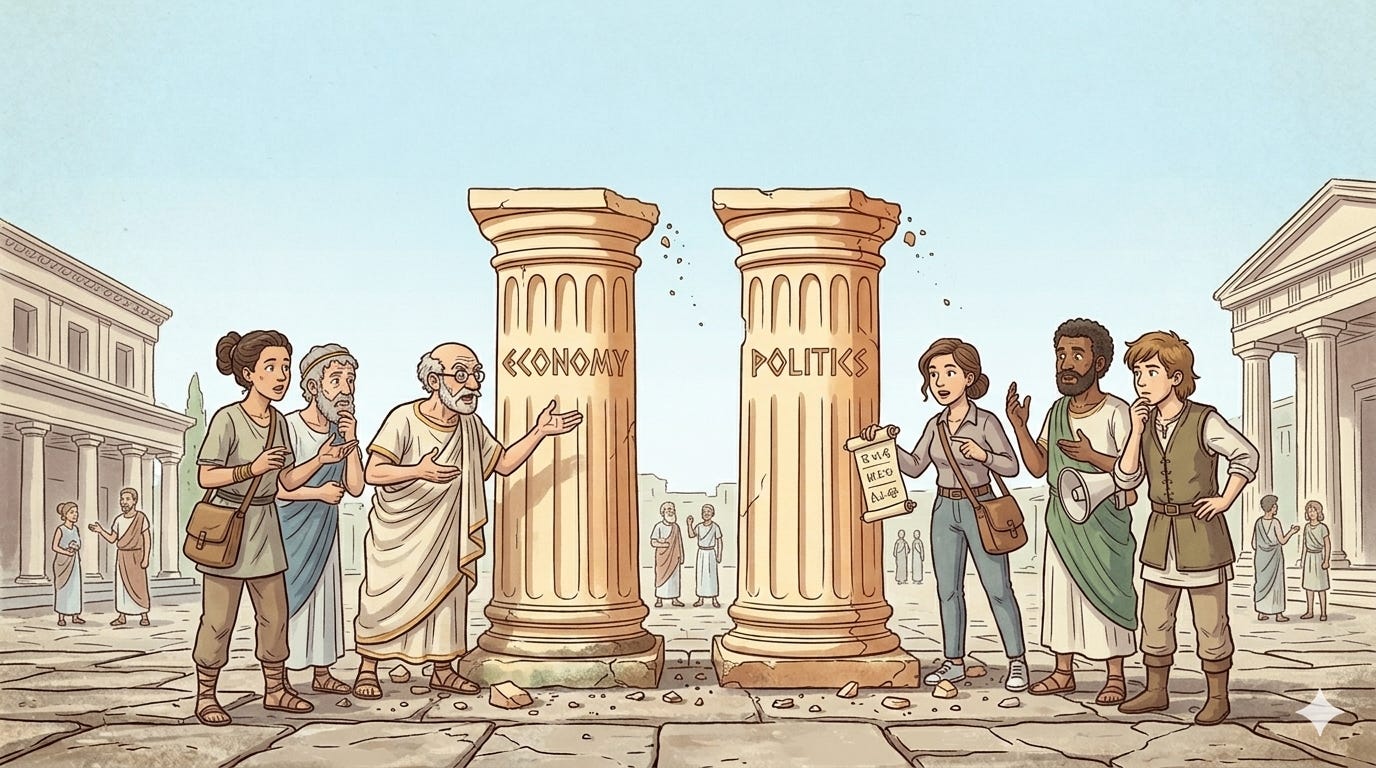
You know this moment. Someone at a family gathering says one of two words: economy or politics. The room shifts. Someone looks at their drink. Someone else decides this is a good time to check on the food. There goes the pleasant evening, or worse, now you must nod politely at opinions you stopped agreeing with three years ago.
Someone pivots to sports. Someone else mentions a new job. The conversation finds safer ground, and the tension drains out of the room the way it always does when those two words get quietly buried. Nobody planned the rescue. Nobody needed to. Everyone already knew the rules.
Crisis averted. Except the crisis was never the conversation. It was the silence that replaced it.
That reaction is not an accident. It is the residue of a departure. Not the kind with a thief. The kind that happens when something drifts so far from its origin that nobody notices it is gone until they go looking for it.
Because these two words, ‘economy’ and ‘politics,’ did not begin their lives in the hands of experts, pundits, or institutions. They started somewhere much closer to home. They started with you.
Where “Economy” Came From
The word “economy” is old. Not just a few hundred years old: ancient in the original sense. It comes from the ancient Greek oikonomia, a compound of two smaller words. Oikos meant the household: not just the building, but everything inside it, the family, the land, the animals, the stored grain, the relationships. Nomos meant management, law, or stewardship. Put them together, and you get “household management.”
That was the whole thing. The economy was not an abstraction. It was the practical, daily discipline of running a home well: making sure there was enough to eat, that debts were kept in order, that work was fairly distributed, and that the household could survive the next season. Aristotle wrote about it. Xenophon wrote an entire treatise on it. It was considered one of the foundational arts of a responsible life.
Every person who has ever stretched a paycheck, planned a grocery run, or chosen between two bills that could not both be paid in the same month has been doing oikonomia, household management in the original sense. The people who feel least qualified to talk about economics are the ones practicing it most directly. They just stopped being told that is what it is called.
When the Household Became a Nation
The slide began gradually. By the 16th and 17th centuries, European thinkers began applying the household metaphor to kingdoms and states. It made sense, on the surface, a king managing a realm was like a father managing an estate. The principles were supposed to be the same. Be prudent. Don’t spend more than you take in. Plan for the future.
The phrase “political economy” emerged during this period to describe the management of the nation’s household. Adam Smith used it. So did the mercantilists before him. The idea was still grounded: the nation was a household writ large, and the same virtues applied.
But a subtle problem entered with the scaling. When the household became a nation, the person doing the managing was no longer someone you knew. It was no longer your father, or the head of your actual household, someone whose decisions you could see and feel and argue with around the table. It was a distant authority. Meaning the subject matter was still familiar but also remote.
How the Economy Stopped Being Yours
The 19th century finished the job. As economics professionalized, it shed the word ‘political’ from its name entirely and began presenting itself as a science: neutral, technical, mathematical. By the time the 20th century arrived, the economy was no longer a household or even a nation. It was a system of flows and equations, something that required years of graduate training to interpret correctly. The branch of economics that took over the policy apparatus was the one that had traveled furthest from the household it was supposed to describe.
The word had traveled so far from its origin that most people no longer recognized themselves in it. What had started as a description of your household became a system that experts monitored with instruments you could not read. And when your lived experience contradicted those instruments, the experts trusted the instruments rather than the individuals interacting with the tangible economy.
When you felt prices were higher, you were told to look at the data.
When life felt noticeably harder, you were told your income had never been better.
The household was heard. It was just consistently overruled by data that missed the point.
The measurement was questioned, but never in a way that reached you. The working explanation was simpler: it is not a measurement problem. It was because you were never good at handling money. You were falling behind because of you. At least, that is what the system said.
Where “Politics” Came From
The word ‘politics’ followed the same path, but the drift left a different kind of damage.
The root is the Greek word polis, which meant city, but not in the way we use that word today. A polis was not just a collection of buildings and roads. It was a community of people governing themselves together. It was a shared civic project. The polis was what happened when free people decided to live together and figure out the rules.
From polis came politeia: citizenship, or the condition of participating in civic life. And from that came politikos: of or relating to citizens, to the polis, to the shared life of free people together.
Aristotle called human beings “political animals” in precisely this sense: not that people are obsessed with elections, but that people are, by nature, creatures who need to live in community and participate in the arrangement of that community.
To be political was not a hobby or a career. It was a dimension of being human.
When Citizenship Became Spectacle
As with economy, the drift happened slowly. By the time the word arrived in the modern era, ‘politics’ had narrowed considerably. It came to mean, primarily, the competition for power: the struggle among parties, factions, and interests. The word retained a sense of civic duty, but the emphasis had shifted from participation to spectacle.
By the 20th century, the average person’s relationship to politics had become almost entirely passive. You voted, if you voted, and then you watched. The professionals took over from there. To ‘do politics’ meant to run for office, to work in a campaign, to hold a position in a party. The rest of the population was the audience.
And then something worse happened: politics became synonymous with dishonesty and bad faith. ‘Don’t make this political’ became a way of asking people to stop talking about the exercise of power over their lives. ‘Playing politics’ became a way of accusing someone of manipulation. The word that once meant ‘participating in the shared life of your community’ had soured into something most people actively wanted to avoid.
The proof is in today’s dictionary definitions. You will find government, power, competition, and manipulation. Merriam-Webster comes closest with a definition about relations among people in a shared area of experience, but even that frames it as something observed, not something practiced. The citizen, the person the word was built around, does not appear in any definition. The word has drifted entirely into the hands of the institutions it was originally meant to hold accountable.
A word that described one of the most fundamental human activities, people deciding together how to live, had been so thoroughly poisoned that reasonable people now use it as an insult.
The Words Drifted. So Did the Instruments.
At its core, this is a claim about measurement. CPI has been understating inflation by roughly 1.5 percent per year, and that gap, compounded over decades, has quietly reshaped what we think we know about economic progress. When you correct for it, the picture changes dramatically. Real GDP per capita since 1910 has grown far less than the official numbers suggest, approximately 40 percent over more than a century, a figure the data supports in detail in The Silent Ghost that Distorted a century of Measurement. That is not the story of surging monetary prosperity we have been told. The physical quality of life today is genuinely better than it was in 1910 in ways that are not in dispute. What the drift obscures is how much of the monetary gain is real and how much is measurement error compounding silently over a century.
But to care about that claim, you must believe that the economy is your business.
You must believe that the numbers being used to describe your life are worth scrutinizing.
You must believe that you are a participant in this, not just a passenger.
That is exactly what the drift of these two words has trained you not to believe.
The economy is a technical system that requires experts to manage data correctly. That much is not in dispute. What is in dispute is whether the methodology those experts rely on is measuring the right things in the right way. And despite the complexity, many have questioned it, including economists inside the institutions themselves. But questioning a measurement without a precise alternative is not enough to change it. The drift was real and widely sensed, but never quantified in a way that connected the mechanism to the household.
If politics is a dirty game played by professionals in distant buildings, and economics requires institutional guidance, then the idea that a measurement error could be the problem and correcting it could be the solution feels too simple. Not because the math is complicated. Because 1.5 percent per year does not sound like enough to explain what households have been feeling for decades. That gap between what sounds significant and what compounds into something enormous is exactly where the argument lives.
Your household is not a passive recipient of economic forces. It is a microeconomy. It produces, allocates, prioritizes, and absorbs risk the same way the larger economy does, just at a scale you can see and feel directly. The national economy is not a different kind of thing. It is your household’s logic multiplied across millions of households and governed by rules that those households rarely get to set. And politics, in the original sense, is the process by which those households decide together what the rules should be. Which means both these things are urgently your concern.
The measurement of inflation is not a technical footnote. It is the instrument by which your household’s actual experience is either recorded or erased. And the question of whether to demand accurate measurement is not political in the soured, modern sense. It is political in the original sense: it is the act of a citizen who has decided to show up.
Taking the Words Back
Reclaiming a word sounds like a small thing. It is not.
Language shapes what we believe is possible. If “the economy” is something that happens to you, then your role is to cope with it, to absorb its shocks, to adjust your budget to its outputs. But if the economy is the collective arrangement of human time and effort, if it is, at its foundation, what you and every other person produce and consume during a life, then the entire logic changes. You are not a passenger. You are a component of the engine. And the instruments used to describe the engine are your instruments, too. The economy does not happen to you. It happens for you. That is what it was always supposed to be doing.
The same goes for politics. When politics means “the shared project of governing ourselves,” then the question of whether our inflation data is accurate is a political question in the best sense: it is a question about whether the tools we use to manage our shared life are honest. It cannot be dismissed as technical, because the answer has consequences for every household budget, every retirement calculation, every policy decision made in the name of economic stability.
This is not nostalgia. Nobody is suggesting we return to ancient Athens or pretend that nation-states can be managed like a single family’s grain supply. The world is genuinely more complex than it was when Aristotle sat down to define his terms.
But complexity is not the same thing as opacity. And expertise is not the same thing as ownership.
The experts can run the models. They can maintain the datasets. They can write the technical appendices. But the purpose of all that technical work is supposed to be the accurate description of something that belongs to everyone: the shared material life of a society. The moment we allow the description to be owned entirely by the people who produce it, without any meaningful accountability to the people it describes, we have made the same mistake that created the drift in the first place.
We turned the mechanism into the point. Economics was never supposed to be the destination. It was the tool a society used to ensure its people could live well. Politics was never supposed to be the prize. It was the process by which people living together decided how to treat each other. When the tools become the point, the people they were built to serve become an afterthought. Reclaiming the words is how you put them back in the right order.
The Rebalancing
This is an argument to put people back at the center. It will be tested on economic grounds and tried in the public square. The data is in the public record. The methodology is open. Anyone who wants to falsify it is invited to try.
But before that argument can land with the people it most directly affects, something must shift. The people who have been feeling the gap between the official numbers and their actual lives have been trained to distrust their own perception. The economy is complicated. You probably just don’t understand it. Leave it to the professionals.
The same shift must happen with politics. The people making decisions are, for the most part, not indifferent to the people they serve. Most entered public life because they believed they could help. But every decision they make is calibrated against the same instruments the rest of the economy runs on. When those instruments are giving wrong readings, good intentions produce misaligned outcomes. The official data says the household is fine. The policy response reflects what the official data says. The household experiences something different and reasonably concludes that nobody is listening. Nobody planned that gap. It is what happens when the compass is broken and everyone, including the people steering, is trusting the compass.”
Both dismissals follow the same pattern. Both use the gap between how things should work and how they do work as a reason to stop participating rather than a reason to demand better. And both leave the people most affected standing outside the room where the decisions are made.
This article is a small act of resistance against that training. Not because feelings are data, they are not, but because the dismissal of lived experience as irrelevant to economic measurement is itself a choice, one that was made by the people who built the measurement systems, and one that can be unmade.
When you bring up the grocery bill, explaining how expensive things have gotten, and someone tells you the economy is fine, they are not giving you information. They are enforcing a boundary: this is expert territory, and your experience is not admissible as evidence. When you bring up the fact that nothing seems to change regardless of who gets elected, and someone tells you that is just how politics works, they are doing the same thing. Your frustration is not admissible either.
Those boundaries need to come down.
The Work That Follows
The rest of this publication is built on the premise that the economy belongs to the people who live inside it, and that politics, at its best, is the name we give to the act of those people deciding together how it should work.
The articles that follow will get into data, methodology, historical patterns, and specific mechanisms. They will be precise. They will be challengeable. That is the point: if the argument cannot survive scrutiny, it does not deserve to.
But none of that matters if the people most affected by a broken measurement system have already been convinced that it is none of their business.
It is your business. It has always been your business. It just got a different name.
Let’s take it back.
Next: With those words back in your hands, the next piece shows the logic was never as foreign as it felt. Continue to "Economics Made Simple: Why Your Household Budget Explains Everything."
Author: Kyle Novack
June 5, 2026
A Monumental Venture, LLC: research project (Novack Equilibrium Theory – NETs)
Attribution Required: © 2025–2026 Kyle Novack / Monumental Venture, LLC. For educational use with credit; commercial use requires permission. Full details in linked PDFs.