

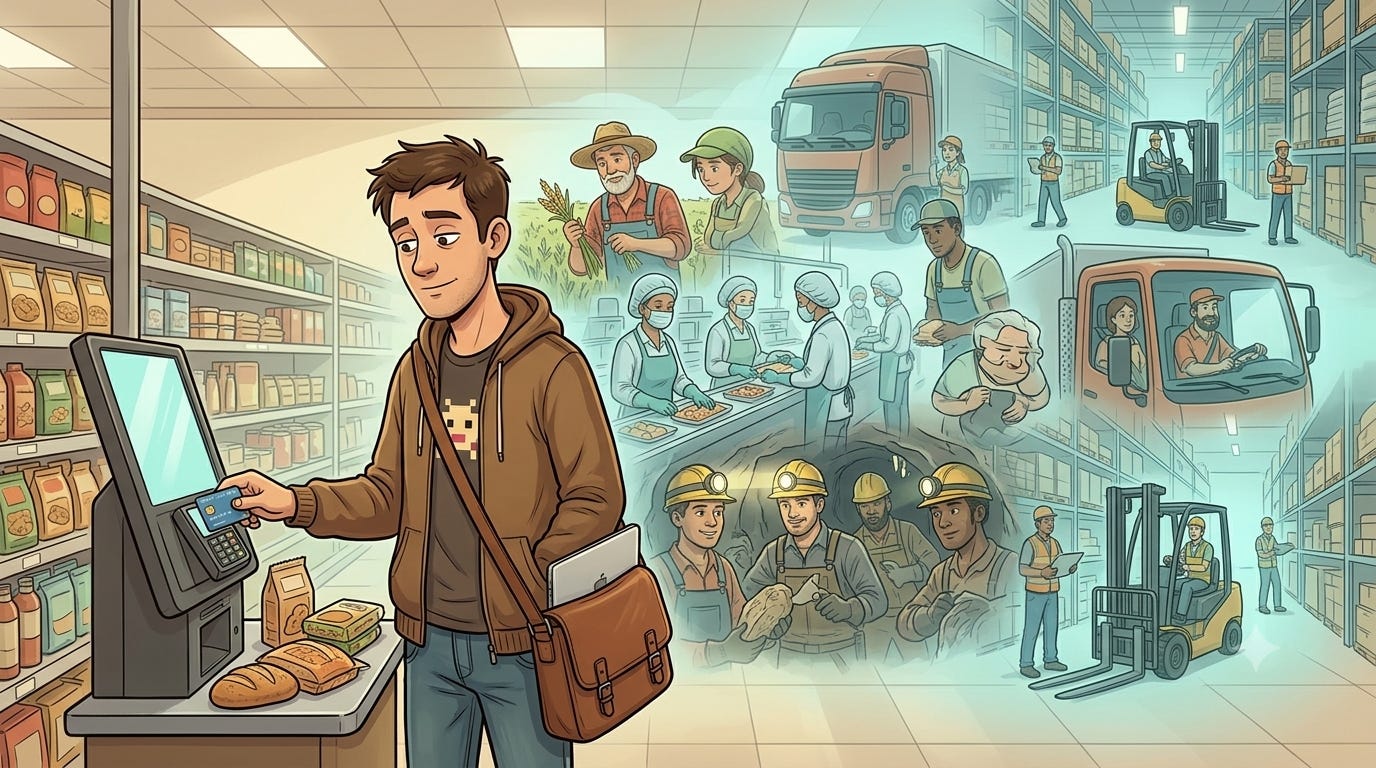
Friday afternoon. Marcus checks his account and sees a number that was not there yesterday. Like anyone getting paid, he thinks about the amount itself, whether it covers what he owes this month, and whether anything is left over. What he does not think about is the fact that a number can do this at all. That an economy with 300 million strangers in it can move value from his effort into groceries, rent, and gas without him locating a single other person by name. That is the entire point. It works so well that no one notices how remarkable it is that we can trade this easily between individuals.
That is what the paycheck makes possible. Marcus writes the algorithm. Apple translates that into a number. The number moves from one account to another. Marcus buys bread, pays rent, schedules the pediatrician, and fills the gas tank, all in the same afternoon, from the same balance, without finding a single person who needs exactly what he has at exactly the moment he needs what they have.
The double coincidence problem that paralyzed Part 2 simply evaporates. Currency does not improve the barter system. It makes the barter system irrelevant. That is not a minor upgrade. That is one of the most consequential inventions in human history, and it deserves to be recognized as such before we look at what it cost.
What the Efficiency Buried
Because it did cost something. There is no perfect solution with no tradeoffs. Every solution to a visibility problem costs something. Money is an abstraction. It stands in for something real, the human time and effort behind every price, and standing in for something is not the same as showing it. The more useful the abstraction becomes, the less anyone needs to look at what it stands in for.
Go back to Thomas and Eleanor for a moment. The potter and the farmer, standing in a village, exchanging a pot for grain. The human time in that transaction was nearly visible. You could look at the pot and roughly estimate the hours. You could look at the grain and understand the season behind it. The effort was legible in the object itself. Neither of them named it as human time. But neither of them could fully hide it either. It was sitting there in the clay, in the weight of the bushel, in the calluses on both their hands.
Now look at Marcus’s paycheck. $8,400, deposited electronically, drawn from a company worth $4.53 trillion. The 11 years of expertise that generated it are nowhere in the number. The low-light algorithm buried inside a billion phones is nowhere in the number. The number is clean and abstract and completely silent about what produced it.
That silence is currency doing its job. The whole point is that Marcus does not need to explain his contribution to the baker to buy bread. The dollar carries the claim without carrying the explanation. That is the feature. But the feature is also the obscurement.
Inside the Price at the Store
Here is what the number is made of. Somewhere in the Democratic Republic of Congo, miners extract cobalt from the ground. The cobalt will eventually become the battery that powers the phone Marcus works on. Those miners work long shifts in difficult conditions. Their hours are in the phone. They are the first layer.
The cobalt moves to a smelter, where workers process it into a usable form. More hours. More human time is added to the object that does not yet exist as an object.
Component manufacturers in South Korea and Taiwan produce the display, the processor, and the camera sensors. Engineers designed those components. Technicians run the lines that produce them. Quality control workers check the output. Every person who touched any part of that process added a fraction of their working life to the thing that will eventually become Marcus’s iPhone. Their time is in it, compressed and invisible, priced into the component cost that Apple pays when it orders the parts.
Assembly happens in factories in China, where workers move through precise choreography, attaching components in sequence, testing each unit, and packaging the finished product. More hours. The assembly worker’s shift is in the phone. The shipping container that moves it across the Pacific required a crew to operate. The port workers who unloaded it. The truck driver who moved it inland. The warehouse staff who sorted it. The retail employees who stocked the shelf and handled the transaction.
And then Marcus himself. 11 years of learning, iterating, failing at problems and solving them, building the expertise that lets him write an algorithm that makes shadows look right in a photograph. His time is the last layer added before the phone reaches the person who buys it.
The price tag is not arbitrary. It is not a negotiation outcome or a marketing decision, though both of those things shape it at the margin. At its foundation, the price is an estimate of everything just described: every hour of every person who contributed to the object’s existence, compressed into a single number that sits on a sticker in a glass display case.
The customer who buys it does not see any of that. They see $999 and decide whether it is worth it to them. The entire human story behind the object has been compressed into a price signal so efficiently that it has become hard to quantify.
This is what currency accomplished. It took the direct human time exchange that Thomas and Eleanor were doing in plain sight and made it so frictionless, so fast, so abstract, that the underlying reality became undetectable in normal economic life.
That is not a criticism. The frictionlessness is the point. An economy cannot run if every transaction requires participants to trace the full human story behind every object they exchange. The abstraction is necessary. The speed is necessary. The invisibility is the price of the efficiency, and the efficiency is worth paying for.
What Compounds When Nobody Looks
But if the abstraction is standing in for something real, then losing sight of it is not just an inconvenience. It is a measurement problem. And measurement problems compound.
When the vessel drifts from what it carries, the measurements built on top of it drift too. GDP per capita, adjusted by official CPI, appears to have grown nearly 600% since 1910. Adjusted for the drift, this framework identifies that the number is closer to 40%. Two frameworks, two completely different stories. Under the standard model, more productivity equals more value: each hour of human time becomes worth more as output per hour increases. Under this framework, the monetary value generated by a human hour remains roughly stable over time, because the human is the ultimate input of the economy, and each person contributes a relatively stable monetary value to the total regardless of how productive their tools have become. The per capita figure, what each person’s time generated, barely moved. Wages look like they have risen dramatically since the 1940s, but much of that apparent rise may be the ruler shrinking rather than the thing being measured growing. Living standards should feel easier to maintain in a more productive society, but for many households, they do not, and the gap between what the numbers promise and what daily life delivers is exactly what a drifting measurement would produce.
There is something about the human hour that nothing else in the economy shares. Once spent, it cannot be recovered or duplicated. Every person alive is governed by the same 24 hours a day, and that has never changed across all human history. This raises a question worth sitting with: why would a baker in 1910, working at peak efficiency for what the tools of that era allowed, earn less monetary value for that hour than a baker today doing the exact same thing with better equipment? The baker’s hour did not change. What changed is how many other people’s hours are now embedded in the process around it. But here is the part that complicates the simple version of that story: the baker has always needed an oven, a bowl, mixing tools, and ingredients. Every one of those things has gotten cheaper to produce over time, because the same productivity gains that made bread faster to bake also made ovens faster to build and flour faster to mill.
The equipment requires less human time than it used to, which is exactly what productivity does: it makes everything along the chain cheaper in human time, not just the final product. That is what makes goods less expensive over time. This alone does not prove the hour’s value has remained constant. But it raises a real question about whether what we call productivity growth is growth in the value of any single hour, or simply the same hours producing more at every stage of the process. The data that would confirm or deny this, including a consistency test using GDP per capita and an adjusted inflation rate, is laid out in full in the Money Series Part 3, for anyone who wants to follow the math rather than take the premise on faith.
Thomas and Eleanor did not have that problem. Their exchange was denominated in pots and grain, and the effort behind each was still visible in the object itself. The trade was honest in the most direct possible sense.
We traded that visibility for the efficiency of abstraction. The trade was worth making. Currency is one of the great human inventions, and the world it made possible is genuinely better than the world before it.
But the abstraction created a gap between the representation and the reality. And gaps, left unexamined, compound.
The economy you are living in right now is the result of that compounding. Not because anyone designed it that way. Not because the system is corrupt or the measurements are deliberately falsified. Because every layer of abstraction that made exchange easier also made it harder to see what the exchange was about.
We just built so many layers between ourselves and that truth that most of us have forgotten it was ever there.
Thomas and Eleanor knew, even without the words for it.
It was always about human time. It still is. The rest of this publication is built on that premise, and on the question of what the economy looks like once you measure it that way.
Author: Kyle Novack
June 14, 2026
A Monumental Venture, LLC: research project (Novack Equilibrium Theory – NETs)
Attribution Required: © 2025–2026 Kyle Novack / Monumental Venture, LLC. For educational use with credit; commercial use requires permission. Full details in linked PDFs.