

There is a version of American monetary history that reads like a conspiracy. Secret meetings in the dead of night. Powerful bankers arriving at a private railcar under assumed names. A plan drafted in whispers on a Georgia island, then handed to a compliant Congress. The story has all the ingredients of a plot, and the names attached to it are real; the meetings happened, and the legislation that followed genuinely did reshape how money works in this country.
It is tempting to stop there. To say: see, this was designed by elites for elites, and everything that followed was the machinery of that design running as intended.
But that is not quite the right story. Or rather, it is not the whole one.
This article is not a comprehensive history of American money. It is a narrative of cause and effect: how each breakdown in the monetary system created the conditions that made the next attempt at a solution feel inevitable. The sources cited here are legitimate scholarly works and provide the broad arc of that history. This is designed to trace the thread, not catalog every detail.
With that noted, to understand the Jekyll Island narrative, we must go further back. Not to 1910 or 1907, but all the way to the beginning of the United States, where a different picture starts to emerge. Not a conspiracy, but something stranger and more interesting: a country repeatedly trying to solve the same problem, failing in different ways each time, and each failure making the next attempt feel inevitable. The secret meeting on Jekyll Island did not create American monetary history. It was the product of it. To understand why it happened, you must start at the very beginning, when the United States did not have a dollar at all.
A Country Without a Currency
When the United States declared independence in 1776, it inherited a monetary mess. The colonies had financed the Revolutionary War partly by printing paper money called Continentals, and printed so much of it that the phrase “not worth a Continental” entered the American vernacular as a synonym for worthlessness. (1) The new nation was born with a deep distrust of paper money and no agreement on how a national currency should work.
Alexander Hamilton, the first Secretary of the Treasury, believed the solution was a central bank modeled on the Bank of England. In 1791, he persuaded Congress to charter the First Bank of the United States: a privately owned institution with a government stake, empowered to issue notes and hold federal deposits. (2) It worked reasonably well. It provided a stable currency, acted as a fiscal agent for the government, and helped restrain the wilder instincts of state-chartered banks.
Thomas Jefferson hated it. So did James Madison. Their objection was not really about banking; it was about power. A central bank meant concentrated financial authority, and concentrated financial authority meant the kind of aristocratic economic structure they had just fought a revolution to escape. When the Bank’s charter came up for renewal in 1811, Congress let it expire. (2) Five years later, after the War of 1812 had ended, leaving the monetary system in extreme disorder, Congress reversed course and chartered the Second Bank of the United States in 1816.
The Second Bank was larger and more powerful than the first. Under the leadership of Nicholas Biddle, it became genuinely effective at stabilizing the money supply and checking the excesses of state banks. It was also, predictably, despised. Andrew Jackson called it a “monster” and made destroying it the central cause of his presidency. (3) In 1832, he vetoed the recharter bill. By 1836, the Second Bank was dead.
What came next was a demonstration of what happens when no one is running the money.
Eight Thousand Currencies
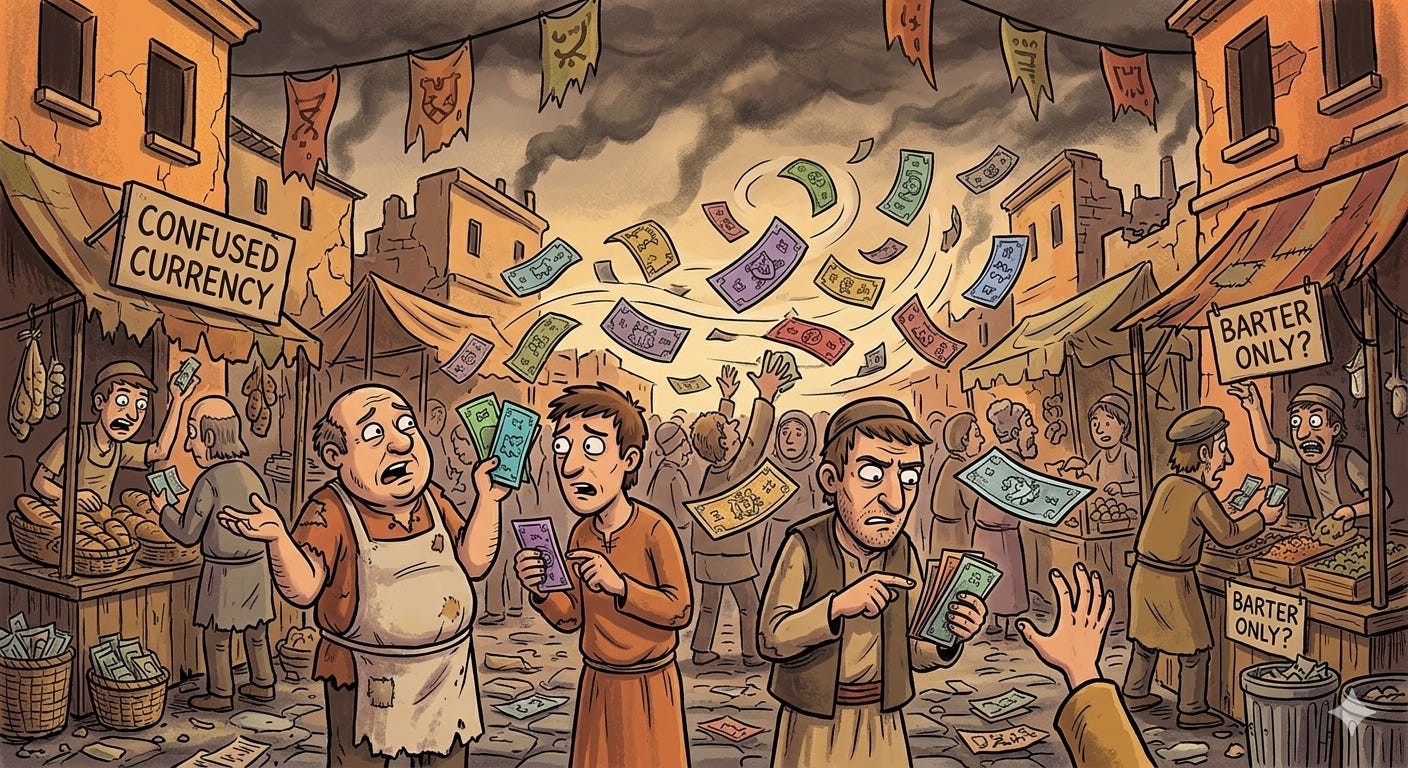
From 1837 to the Civil War, the United States operated under what historians call the Free Banking Era. There was no national currency. At the peak of this period, there were more than 8,000 state-chartered banks, each issuing its own distinct paper notes, with some estimates counting over 10,000 different varieties in circulation by 1860. (4)
This was not chaos in theory. The logic behind free banking was coherent: let banks compete, let the market sort out which notes held value, and let depositors punish reckless institutions by withdrawing their business. Competition would enforce discipline better than any regulator.
In practice, that theory fell apart. A dollar issued by a Boston bank might trade at face value in Boston and at a fifteen percent discount two states away, if it was accepted at all. (4) That discount was not a sale price; it meant that a note printed as a one-dollar bill might only buy eighty-five cents’ worth of goods the moment you crossed into a different region, simply because the merchant receiving it had no way to verify whether the bank that issued it still existed or had enough gold to back its notes. This led merchants in frontier towns to subscribe to Bank Note Reporters, publications that listed the current discount rates on notes from hundreds of different institutions, updated weekly, so they could figure out what each piece of paper was worth on any given day. (4) A natural consequence of this confusion was rampant counterfeiting: with thousands of different note designs in circulation, no one could keep track of what legitimate currency even looked like.
The absence of any central oversight did not just create confusion; it created a legal opportunity. With no federal authority to set standards or enforce accountability, there was nothing to stop operators from exploiting the system entirely within the bounds of the law. The result was the so-called “wildcat banks,” institutions chartered in remote locations, with assets backed by questionable collateral and often deliberately situated far from population centers to make redemption practically difficult. Communities had no protection and no recourse, and these banks became a defining feature of the era. (4)
It is worth noting that historians still debate how deliberate this exploitation actually was. Some scholars argue that most wildcat bank failures resulted from falling bond prices rather than intentional fraud. What is not debated is the outcome: the system’s structure made exploitation possible, legal, and in many cases unavoidable, regardless of intent (5)
Either way, commerce suffered. But the damage did not stop there.
The Panic That Kept Repeating
The surface-level chaos of the Free Banking Era was only part of the problem. A deeper consequence was already forming, and it arrived almost immediately after the Second Bank closed its doors. The Panic of 1837, which hit within months of the Second Bank’s closure, triggered one of the worst economic contractions in American history. Banks across the country suspended specie payments: they stopped converting their notes to gold or silver on demand. Hundreds of banks failed. A depression lasting roughly six years followed. (6)
That pattern repeated. It happened again with the Panic of 1857, and again with the contraction that followed the Civil War. Each time, the absence of any central authority meant that when banks began failing, there was nothing in place to provide the emergency liquidity needed to stop the cascade. Each financial crisis ran its full, brutal course. (7)
The Civil War forced the issue, at least partially. The federal government needed to finance an enormously expensive war, and the existing patchwork of state banknotes was not up to the task. Lincoln’s Treasury Secretary, Salmon P. Chase, pushed through the National Banking Acts of 1863 and 1864. (2) The legislation created a system of nationally chartered banks that could issue standardized national bank notes backed by U.S. government bonds. In 1865, Congress imposed a ten percent tax on state bank notes, killing off the competing state bank currencies and effectively making them unprofitable to issue. (8)
For the first time, the United States had something approximating a uniform national currency. It was real progress. Commerce became easier. National trade became more reliable. The era of the Bank Note Reporter was over.
But the National Banking system had a structural flaw that would eventually prove fatal. It had no lender of last resort. When a bank faced a run, when depositors spooked by rumors or actual trouble arrived demanding their money simultaneously, there was no institution that could step in with emergency liquidity. Each bank was on its own. And when one bank started to fail, the fear spread to others, because the notes and deposits of failing banks were held across the system.
The result was the “inelastic currency” problem: the money supply could not expand quickly in response to a crisis. And without that capacity, panics had a tendency to become catastrophes. (7) In 1873, a panic. In 1884, a panic. In 1890, another. In 1893, a severe crisis that brought hundreds of banks down and drained the Treasury’s gold reserves so completely that a private Wall Street bailout was the only thing standing between the United States government and default. The system was better than the Free Banking Era, but it was still one bad autumn away from collapse.
For farmers and working people, the post-Civil War deflation was not an abstract economic condition; it was a daily reality. Crop prices fell steadily through the 1870s and 1880s as the money supply contracted relative to economic output. Debts contracted in one dollar were being repaid in dollars worth significantly more. (9) A farmer who borrowed $1,000 to plant in 1870 and repaid it in 1885 was effectively repaying more purchasing power than he had borrowed, because each dollar commanded more goods as prices fell.
This is where the political explosion came from. The Populist movement of the 1880s and 1890s, the campaigns for free coinage of silver, the fury at the railroads and the banks, William Jennings Bryan’s famous “Cross of Gold” speech in 1896, was not irrational or merely rhetorical. It was a coherent response to a monetary system that was systematically transferring wealth from debtors to creditors through deflation. (10)
Solutions That Became the Next Problem
That deflation and the political fury it produced were not isolated failures. They were the latest chapters in a pattern that had been repeating since the founding of the republic.
Look back across those 120 years, and the pattern becomes visible. It is not the pattern of a conspiracy, though powerful interests were present at every turn. It is the pattern of human beings trying to solve a genuinely hard problem with the tools and knowledge available to them, succeeding partially, creating new problems with their partial solutions, and handing those new problems to the next generation.
Hamilton’s First Bank was a good solution, but politically unsustainable. Jackson destroyed it for reasons that were emotionally coherent and economically costly. The Free Banking Era was a principled experiment that failed in practice. The National Banking system was a genuine improvement with one critical missing piece. Each step solved something and left something else broken.
That is not a conspiracy. That is how large, complex systems evolve: not through coordinated design, but through a series of responses to the failures of what came before. Each correction moves the problem somewhere slightly harder to see. The blind spot does not compound so much as it migrates, always one step ahead of the solution being applied to it.
By 1907, the blind spot had a name: there was no lender of last resort. Everyone who understood the banking system knew it. The question was not whether it needed to be fixed, but who would do the fixing, and on whose terms. The answer to that question would be hammered out in the most dramatic backroom negotiation in American financial history, and the terms of that negotiation still shape the economy we live in today.
That story begins in the next part of this series.
Next: One man's rescue of the system in 1907 is what finally forced the country to ask whether a financial system should depend on personal heroism at all. Continue to "The Rescue That Couldn't Be Trusted to Happen Again."
References
Galbraith, J. K. (1975). Money: Whence it came, where it went. Houghton Mifflin.
Hammond, B. (1957). Banks and politics in America from the Revolution to the Civil War. Princeton University Press.
Remini, R. V. (1967). Andrew Jackson and the Bank War. W.W. Norton.
Mihm, S. (2007). A nation of counterfeiters: Capitalists, con men, and the making of the United States. Harvard University Press.
Rolnick, A. J., & Weber, W. E. (1983). New evidence on the free banking era. American Economic Review, 73(5), 1080–1091.
Rezneck, S. (1935). The social history of an American depression, 1837–1843. American Historical Review, 40(4), 662–687.
Sprague, O. M. W. (1910). History of crises under the National Banking System. Government Printing Office.
Timberlake, R. H. (1993). Monetary policy in the United States: An intellectual and institutional history. University of Chicago Press.
Hicks, J. D. (1931). The populist revolt: A history of the Farmers’ Alliance and the People’s Party. University of Minnesota Press.
Goodwyn, L. (1976). Democratic promise: The populist moment in America. Oxford University Press.
Author: Kyle Novack
May 19, 2026
A Monumental Venture, LLC: research project (Novack Equilibrium Theory – NETs)
Attribution Required: © 2025–2026 Kyle Novack / Monumental Venture, LLC. For educational use with credit; commercial use requires permission. Full details in linked PDFs.